Showing posts with label urban planning. Show all posts

Tuesday, September 20, 2011

A New Life in the Infinite City

It has been a little over a month since I packed my bags, loaded up the UHaul, and set sail for San Francisco. Since then, my main priority has been finding a job (or even a part-time "yob"). So apologies, again, for not maintaining this here blog up to my usual standards. As of this writing, I have not yet found a job but have made some good progress to that end. At the very least I have interviewed for positions far more frequently than I could've ever predicted. 


For those of you who're interested, here is a brief update on the job search:


First, the bad news...I have been rejected for the following positions:

  • Sales coordinator position at a Facebook-related, early-stage startup in SoMa (rejected after two interviews)
  • Customer service position at an events and ticketing late-stage startup in SoMa (rejected after two interviews)
  • Executive assistant position at an international non-profit foundation (rejected after one interview)
  • Admissions representative at a private university Downtown (rejected after one interview
  • Recruiting position at a pharmaceutical staffing agency (declined the position after a phone screen)


Now for the bright spots of the job search, for opportunities still pending:

  • Project coordinator position at an affordable housing developer in Civic Center - this is the opportunity I'm most excited about :)
  • Policy analyst at an insurance-related non-profit Downtown
  • Contracts clerk at a solar company in San Mateo
  • Admin at a private university Downtown
  • Project coordinator position at a climate change think tank in Berkeley
  • Two large temp agencies


So as you can see, not all is lost as the job hunt goes on. The positions that are still in the cards for me are far and away much better fits than those for which I've been turned down. I sometimes forget in the stress of applying to and interviewing for jobs that as much as the employer is interviewing you, you are interviewing the employer to find the best match for you. 


The importance of this is easy to overlook when at the end of the day I just need a job to pay my bills. But will it be a job that I enjoy, somewhere I can thrive over the long-term and find real growth opportunities and maybe even a career? Something tells me it was for my own good that the sales and customer service-related positions passed me over. Perhaps they sensed (correctly, I think) that I wanted more out of a job than answering phones all day or mindlessly crunching numbers. Dare I say it, I want a career and not just a dead-end job? So those outcomes can be seen as a blessing in disguise, I suppose.


In the meantime, I cannot praise the temp agencies in San Francisco highly enough. If you ever find yourself unemployed (or under-employed) in a big city like SF, I highly recommend that you get yourself into the local temp agency for an interview. 


The first temp agency I met with (who will remain confidential as I am still working with them) was tremendously helpful. I was referred to the agency by my good friend Elyse, who got a kickass job at Pandora with their placement services. She began as a receptionist and has since been promoted twice, first to recruiter, now to events specialist. She has been working there since January, mind you. Elyse is also responsible for helping us find our apartment and has truly been an indispensable resource in helping us getting established here. Love you, Elyse! Her story is one that I think could only happen in a place like San Francisco.


So after Elyse referred me to the temp agency, I applied for several jobs within a few days of getting into town. Not even twelve hours later, I get an invitation to interview with one of their recruiters. Now that's service! 


The first woman I met with took one look at my resume and made clear, precise recommendations for several types of positions, such as administrative, sales, or customer service. She told me what to cut (a lot!), what vocabulary to change, and what to embellish for my job search. Another woman I met with had already reviewed my resume and had a position at a biodiesel company already in mind. The position ended up not being available, but the fact that she was able to recommend me for a position in a field I've already blogged about here is a testament to her diligence.


The agency also hooked me up with several days' temp work as an usher at the recent Dreamforce conference at Moscone Center, run by the local software giant Salesforce.com. In case you're wondering what the hell Salesforce is, don't worry...Salesforce is the future, and the future is terrifying! It's basically a sales database system that combines the powers of every social network into one: Facebook, Skype, Twitter, LinkedIn, and Amazon.com, all seamlessly integrated. 


Imagine the following scenario: you walk into a Nordstrom's and buy a pair of jeans. Upon ringing you up at the register, the sales clerk registers the transaction into Salesforce, where not only your credit card information, but also your Facebook profile, Twitter feed, blog presence, and nearly every other social footprint online is stored. An inquiring salesperson or advertiser would then be able to search your profiles and "recommend" your next purchase based on the interests you've expressed on your social networks as well as those expressed by any of your hundreds of online friends.


Maybe I'm being paranoid here, but this technology is quite frightening and makes me take pause at how my online presence could potentially be used for sinister purposes. After ushering the VIP section at the Dreamforce keynote address by Marc Banioff, I can tell you that what I've described is merely just the beginning of what Salesforce has in store. Coming soon are internal company Facebook-like social networks, where any employee in a closed network can post company updates, share documents, or even schedule online conferences. 


Let's take the next technological leap into the future for a second. Facebook has recently announced a hair-raising new facial recognition technology. You heard right. Technology now exists that can search for and locate your Facebook (and countless other Internet profiles) based on a quick and dirty photograph of your face. See below:


video platformvideo managementvideo solutionsvideo player


Now let's take a paranoid leap of faith and assume that enterprising companies like Salesforce snap up this technology in a split-second, paying no heed to the public's concerns over breach of privacy. Because you know that's exactly what will happen. Now the sales clerk at Nordstrom's need not have your credit to look up your social presence online. It can now be done by video cameras the instant you walk into the store. Is it just me, or does this not sound exactly like one of the more disturbing scenes from Minority Report?


Run for your lives, children! The future is already here...


Now for less depressing geekiness. My mom gave me the book Infinite City before I left for San Francisco. It is nothing less than one of the most interesting books I've read in years and was the best possible book I could've read before moving to the city. Infinite City is a collection of maps and accompanying essays that charts the social, economic and cultural history (and future) of San Francisco through the lens of very diverse groups. Written with the premise that every person who lives in the city could write their own infinite series of maps based on their individual life histories (places of residence, watering holes, restaurants or markets they frequent, places they walk their dog) that themselves comprise the fabric of the city. It is a radical concept, that cities are composed of a tapestry of millions of individually situated maps of our livelihoods.


Here are some of the best examples of this type of psychogeography:


The "phrenology" of San Francisco - the city as it reflects within the human psyche


Gay bars and endemic butterfly species - a great pairing if there ever was one!


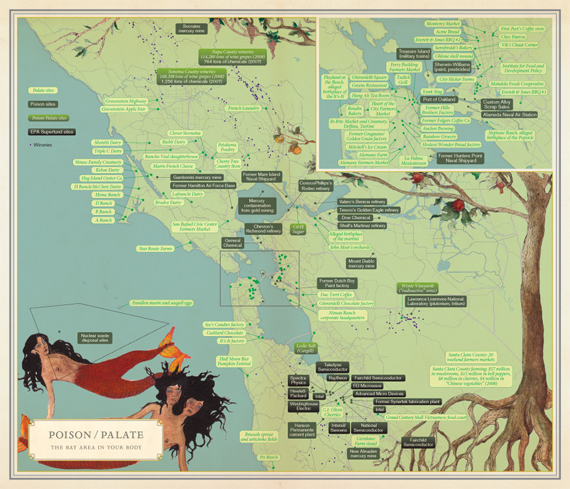
Poison vs. Palate - toxic waste sites overlaid ontop of gourmet foodie destinations -  "What doesn't kill you makes you gourmet"


Old-style movie houses and scene locations from Alfred Hitchcock movies


Infinite City is the only book I've ever read that truly achieves what a map should as an art form. As a student of geography and GIS, I wish I had been more educated on some of her methods and encouraged to try more or Solnit's wildly imaginative interpretations. Few things are as hard to map as history and culture, for these are nonlinear and fluid concepts. As the author states, any interpretation of our sense of place is situated by our individual experience; there are therefore an "infinite" number of maps that each of us could make of the city, and each would be artistically relevant. Infinite City does a great job of highlighting both the more popular stories/folklore of San Francisco through her maps, as well as those most of us are not brilliant enough to imagine. 


Solnit has a keen sense of duality and contradiction, which shows in her cartography. "Poison and palate", the interplay between toxic waste generators and gourmet food destinations and how the two are not at all unrelated. "Phrenology" of the city was another of my favorites. As I finished Infinite City, I was left scratching my head wondering 1) why geography students aren't educated to value maps in the artistic sense; and 2) why aren't there more books like Infinite City for the other great cities of the world! Infinite City is a fantastic read, highly recommended.


That's all for now, folks! I'll be sure to post again when I have more news on the jobs front, if not sooner. To a new life in the Infinite City!

Friday, June 17, 2011

How to Pick Up a City Planner

It's no secret that urban planning is probably considered one of the unsexiest professions in existence, right up there with engineering or social work. All that talk about mixed-use development, electric cars, or bike-sharing isn't texactly going to get anybody sprung...

Thankfully, our friend Emily at Irish Breakfast has developed a helpful guide for how to pick up a city planner at your local zoning meeting, design charette, or organic microbrewery. Hint...we're not a tough crowd! I encourage you to practice any one of these one-liners at your earliest convenience :)


Via: Irish Breakfast

Saturday, May 21, 2011

Los Angeles Busts Out a New Chapter in Planning

California has been on my mind for quite some time now. Not only have I been envisioning what my future residence in California will look like, but I've also been scouring the Interwebs for the "next big thing" in the state's urban planning world. I'm slowly coming to terms with the fact that I won't be able to make a living as a city planner, in any capacity, with only a Bachelor's degree. This, sadly, has been a delusion that I've had to get over rather quickly since graduating from UW. But let's sit back for a second and get a bird's eye view of reality. I figure that if I'm going to make a go at city planning as a career, then I sure as hell better have my finger on concrete projects I could work on when I'm finished with grad school. As they say, if you can dream it, you can do it!

The big picture is that out of California's diverse urban landscapes, the city of Los Angeles holds the most potential as a hotbed of innovative urban planning ideas and projects to engage with. Part of this is just due to the sheer size of LA as America's second biggest city, with nearly 13 million people in the metro area. There are world-class urban planning programs at both UCLA and USC that are of great interest to me. But more importantly, there is an abundance of urban planning projects ripe for the taking mostly because LA's urban planning processes and history have been so thoroughly, utterly fucked up.

The common maxim is that “if aliens were looking down on Los Angeles, they would come to the conclusion that the dominant life-form is the automobile”. Another suggests that even talking about LA as a coherent city is itself specious, that Los Angeles is a series of "72 suburbs searching for a city." How did things get to hell in a handbasket so fast? Why is LA so universally regarded as an urban planning catastrophe?

First, LA was dealt a bad hand simply by experiencing nearly all of its growth as a major city in the immediate post-WWII era. This was a time when the Interstate Highways Commission was pumping billions into brand new freeways. Simultaneously, the Los Angeles Railway, the city's former system of streetcars once among America's most extensive, was being bought out by General Motors and replaced with stinky, polluting diesel bus lines that - surprise! - no one wanted to take. The "locus" of downtown Los Angeles was beginning to become blighted long before the city entered its greatest period of urbanization from the 1960's onward. The dominant entertainment industry, where most of the city's jobs are, was decentralized and favored large studio warehouses in outlying areas, not the kind of centralized factories that solidified the urban centers of most American cities that came of age pre-WWII. These factors encouraged sprawling development patterns for both residential areas and employment centers. And LA's heavenly climate doesn't exactly discourage a car-oriented lifestyle with big, suburban lawns and white picket fences, now does it?

Of course, the suburban dream didn't quite work out as planned for LA. It goes without saying, of course, that LA has America's worst traffic, bar none. The city also has some of the worst social inequality in the US, the infamous Watts and Rodney King riots are only symbolic of this disturbing trend.

However, all is not lost! There are a whole host of new developments pointing toward a sustainable future for LA. Here's a recap of some of the most exciting ones:


1. TRANSIT

LA is already ranked the 3rd best city for transit, according to US News & World Report. Even though most of the native Angelenos I know would never dream of taking public transportation, this isn't to say that there isn't public transit available. Mayor Antonio Villaraigosa has already pledged to accelerate the city's investment in transit, especially rail rapid transit, by building at least $13.7 billion in subways, light rail, and commuter rail in a 10-year time frame, rather than the 30-year plan originally outlined. The expansion of the Expo subway line to Culver City and eventually Santa Monica, two hubs of the perpetually traffic-choked and densely-populated West Side, is the plan's centerpiece.

Additional lines are planned for Westwood/UCLA (Purple Line), the San Fernando Valley (Orange Line), Pasadena to Pomona (Foothill extension), Santa Ana commuter rail, and LAX (Crenshaw corridor). This would be the first time in LA history that the city had three rail projects under construction at the same time.

 Villaraigosa's proposal is probably the most ambitious one for rail/subway transit in the US today. When California voters passed Measure R in November 2008, they agreed to a half-percent increase in sales tax to fund $27 billion in transit in thirty years. So how will LA accelerate these projects when Measure R is only supposed to generate about $3 billion in ten years? Ask the feds for money, and then pay it back when Measure R's funding kicks in completely by the end of the 30-year window. If  this deal is packaged the right way, the federal government could get a significant benefit by lending LA this unprecedented sum of money. Not only will the local economy get a boost (leading to increased federal payroll and gas taxes from the thousands of construction jobs that will be created), but the federal government will also play a hand in solidifying LA's future as a progressive, transit-based city of innovation. Loans to fund this new infrastructure could lure hundreds of thousands of jobs and new residents to the city, whose growth would pay back the loans. China's Special Economic Zones of Hong Kong, Shenzhen, and others have been given a similar treatment over the years, with great success.

LA's ambitious plan to building 30 years of public transit in only 10 years
2. BIKES

The Los Angeles City Council in March approved a plan calling for 1,680 miles of interconnected bikeways. This is a huge event equivalent to building 50 miles of bike lanes per year for thirty years! And it will go a long ways to encourage would-be cyclists previously terrified (with good reason!) by the city's traffic-choked and unfriendly streets, to take to the streets safely.

Map of LA's new system of 1,680 miles of bike lanes and boulevards planned by 2038
This heavy dose of bike infrastructure is also being funded by Measure R, 10% of which was dedicated to bicycle transportation. Here is a link to the full bike plan and more details from GOOD magazine:

The plan promises several changes for L.A. bikers: the Citywide Bikeway System will introduce three new interconnected bike path networks—Backbone (long crosstown routes on busy streets), Neighborhood (short connectors through small streets) and Green (along recreation areas)—throughout the city, a new pledge for Bicycle Friendly Streets will make streets more pleasant for riders and walkers, and a series of education programs and safety policies will help cars and cyclists co-exist. 
Of course, the LA Citywide Bikeway System is still in its conceptual phase and will require a great deal of commitment from the city to actually become a reality. Even so, the plan makes clear and definite the policy choices that Measure R will be allocated into, so even producing this long-range plan is a huge step forward for LA.

So what kinds of infrastructure could the bike plan lead to?

The plan will begin with bike accommodations we regularly see here in Seattle, like "sharrows" and dedicated bike lanes. Later on, bigger projects will include "bike boulevards" and traffic-separated bike lanes that until now have been almost exclusively the domain of cities like Portland, OR and Amsterdam, which I covered here.

Rendering of a "bike boulevard" planned for downtown Los Angeles

Some of the first traffic-separated bike lanes in Southern CA just opened in Long Beach a few weeks ago, and they provide a glimpse (hopefully) of what is to come to the rest of the metro area.

Bike lanes in Long Beach, CA

3. PEDESTRIAN IMPROVEMENTS

Figueroa Street, which runs through downtown and connects with the USC campus, is one of the streets identified as a Backbone corridor, which means its bike and pedestrian improvements will be given highest priority. In all, the street is nearly 30 miles long and is without doubt one of LA's longest and least pedestrian-friendly streets. Copenhagen-based Gehl Architects, of Cities for People fame, are already working on providing bike lanes, improved sidewalks, mixed-use development that embraces street level uses, and what to do with the nearly 545 acres of parking lots within a half-mile of the Figueroa Corridor. More info from GOOD:

The proposals for Figueroa Street are divided into "good," "better," and "best." The entire street would be configured to the "good" specs, with the protected bike lane, more trees, new paving, and general improvements to the pedestrian experience with crosswalk striping and mid-block crossings. The "better" and "best" schemes would be seen at more high-traffic intersections, like near Staples Center and USC's Galen Center.

Vision of a future Figueroa Street landscape. Doesn't it remind you just a bit of Las Ramblas?


An even more groundbreaking proposal comes from three architecture students at Cal Poly: why not ban cars from downtown LA entirely? A baffling 36% of the space of downtown LA is used for parking lots and garages for in-coming commuters. What if that were replaced by more housing, parks, plazas, transit, and all the other things we actually love about cities? Have a look at the slick video they produced for more info:


Downtown Los Angeles from tam thien tran on Vimeo.


Finally, I leave you with an inspirational passage from Tim Halbur of GOOD magazine:

I live in a beautiful old apartment in an historically preserved neighborhood filled with trees. Most mornings, I walk three blocks to the nearest rapid-transit stop and take a 10-minute ride past a major art museum, a couple of beautiful art deco theaters, and several busy shopping and office districts. On alternate days, I bike the four miles, stopping at any one of the many sidewalk cafes along the route before settling into my desk on the fifth floor of a 10-story office tower. 
Would you believe I live in Los Angeles? 
Most people picture sprawling suburbs with deteriorating lawns, framed by minimarts and overshadowed by the Hollywood sign. The corner minimarts are there, but they border old neighborhoods thick with duplexes and other lowrise multi-family dwellings, the kind of dense living quarters that are all the rage among urban planners. In fact, Los Angeles has more people living closer together than Portland, Oregon, the current poster child of urbanism. And depending on where you draw the lines, L.A. is denser even than New York City.

But where Los Angeles differs from those urban cities is that it is really, really big. While the County of New York is less than 23 square miles, Los Angeles County stretches across 4,083 square miles, larger than all of Rhode Island and Delaware combined. And while walkable neighborhoods like mine flourish in many cities across the county, the last 70-odd years of history have decimated the relationships between them. When talking about cities like Cleveland or Pittsburgh, city planners and architects refer to the dead or under-used areas as “broken teeth.” Well, Los Angeles might as well be a washed-up prizefighter, because there are a lot of gaping holes between those pearly whites. 
But all is not lost. Before we revert to old stereotypes about Los Angeles as a Blade Runner-esque dystopia, I’m here to report the good news: The City of Angels is turning away from that imagined future and heading toward a much brighter past.

So even though I'm not chomping at the bit to move to LA just yet - San Fran wins in so many areas it's not even funny :) -  it's good to know that even the most recalcitrant, stubbornly car-oriented cities can still be reborn into somewhere we would actually want to live!

Friday, May 13, 2011

Will Microsoft Be the Google of EV Charging Stations?

Cellphone apps and other corporate tech partnerships are quickly filling the void of governments to provide information to the public about where to find an EV charging station. In an industry so heavily subsidized by the feds (you can get a $7,500 rebate for buying just about any EV model on the market), you would think the associated infrastructure for cars would get attention from the public sector.

However, if you take a look at the recent budget cuts that were approved in Washington DC several weeks ago, it's becoming clear that projects dependent on federal funding for green projects - this runs the gamut from high-speed rail, electric vehicles, public transit, and other sustainable urban planning methods - are facing a grim future.

The highlights from the impending doom scenario?
  • $34 million cut from the Renewable Energy Program (Agriculture)
  • $80 million gone from the Environmental Quality Incentives program (Agriculture)
  • about $900 million cut from FEMA - God help us if when we see another hurricane like Katrina (Homeland Security)
  • $50 million from Climate Change programs (Interior)
  • $25 million from FTA Energy Efficiency Grants (Transportation) that funded much of California's EV charging infrastructure
And....the big ticket items:
  • $2.9 billion eliminated from high-speed rail (HSR) funding, before even a single mile of it has been built in the US! The "flagship" line under construction between LA and SF might well be the only one at this rate. This comes as many of the more idiotic Red States are having the gaul to reject HSR funding and return it to the feds! No thanks, Obama :) You can take your cutting-edge infrastructure and thousands of construction jobs, because WE DON'T NEED THEM! Is it just me, or do Republicans have a near-perfect record of laying waste to the projects big cities need for their economic survival?
  • $3 billion gone from highway construction - part of these cuts make sense, there is definitely a solid argument that highways encourage poorly-planned, sprawling development patterns. But do Republicans hate both trains and highways, or just hate any kind of movement in general??? I just don't get it.
  • $600 million gone from public housing programs like HOPE VI and Section 8
And things looked so good for environmental projects back in 2009 when Obama passed the ARRA. So this is the funding void we're dealing with for EV infrastructure.

Thankfully, big corporations like Microsoft and Google are seeing the tremendous opportunity that investing in EV infrastructure holds.

The database is called the Microsoft Utility Rate Service (MURS), and it will be available via subscription to government agencies, power providers, auto makers, and electric vehicle charging equipment companies. It will allow consumers to search the full range of EV charging utilities to find the best deal on charging electricity nearest them.

More info from the Inhabitat story:

According to Warren Dent, director of business development at Microsoft, MURS will be offered in at least 17 different markets — mostly on the East Coast and West Coast — but also including cities like Detroit, Denver, and Chicago.
To get going, Microsoft is collaborating with one-to-three utilities in each region to get access to the data, and is expecting that its partnerships with companies like Duke Energy, Xcel Energy, and Portland General Electric will provide it with more relevant information. The pricing information will then be sent from the utility companies to Microsoft, which will relay that information to MURS subscribers. MURS sends the data directly to the plug-in vehicle, eliminating the need for interaction with drivers.
Currently, Ford is utilizing on Microsoft’s service to allow its drivers to charge their cars when utility rates are lowest.
Hmm....so kind of like a Craigslist for where to plug in your EV batteries? Hopefully this will level the playing field as far as EV charging networks are concerned and allow more innovative companies enter the market and offer cheaper alternatives we can take advantage of. Microsoft may be a dinosaur among the high-tech world, but here its program sounds like a winner!


Via: Inhabitat 

Saturday, May 7, 2011

California Dreamin'

All right everybody, it's time I leveled with my readers for just a bit. One of the main constructive criticisms I've gotten on this blog is that it's not very personal - there's not enough David-ness about it. I will admit this is true, it's mostly not my style to actually blog about my personal life and way easier to geek out about news, culture, or current events. Guilty! I also worry about the long-term consequences of having a LOT of personal information permanent published to the web. As many folks have discovered, your Facebook, Twitter, Blogspot, and many other profiles leave an indelible residue online even long after you've closed your accounts. Countless hapless people today are in lawsuits over termination from their jobs due to some of the less-than-professional behavior they've posted to the Interwebs. So let's just say I try to err on the side of caution, with some exceptions, and not reveal anything I wouldn't in a job interview or conversation with a stranger in the grocery store. 


Now for a change of pace! Time to get fucking personal for a second. I've been gearing up for a move to California this August for several months now. Part of my motivation for doing so is career-related - I'll just leave it at that :). 


I started looking fiendishly for jobs last year in the run-up to my graduation from UW for two reasons: 1) I wanted to gain a year or two of solid career experience before going back to grad school; 2) I simply didn't know how else to support myself independently. I wasn't comfortable with doing some of the things many of my friends had done post-graduation. Travel the world for a year? Sure, who wouldn't love to do that? I had just studied abroad for six months of '09 in Spain and I honestly didn't want to leave :D But after graduation, when the premise of "academics" (using the term loosely) is gone? How would I justify that to my parents, or to my depleted bank account? In some respects, I regretting rushing into the career world with such intensity and wish I had been more thoughtful about the choice I ended up making. Just because a company wants recent college grads and sounds good in its offer letter doesn't mean it's the right fit. This doesn't mean that my company is a bad company, just perhaps not the right fit at this point in my life. Bottom line: I'm starting to realize I want a bit more excitement and, frankly, danger,  in my life than any 9-5 career-oriented job can give me.


At 23, I have already accomplished a full-time, salaried, managerial position at a major facilities corporation. Sometimes I lose sight of the fact that I'm still young and have many more years of working drudgery ahead of me. Many of the people I meet in a professional context are flabbergasted when they realize my age, as if stunned to see that I've made it to the level of being their perceived equal so quickly. "How did you become a Safety Manager?" (at 23) is one of my favorite questions I could be asked, and there is a long and juicy story behind it for those who are interested. My point is that I've already achieved a lot of what I had intended to when I first entered the career world after graduation last year. So there is no real rush to that next promotion, or even a "lateral move" to another company. Many people who are in their late 20s or even 30s are still waiting tables, temping, "interning", or otherwise indulging in the life stage that's coming to be known as "adultolescence"


Which brings me to California...Ah, yes - magical, sunny, clusterfuck California! Matt and I are looking at California not just because of its weather and for a change of pace - it's the chance to have the freedom and yes, perhaps just a bit of "edginess" that life in Seattle seems to have exhausted itself of. Our friends are intimate and well-established, we have good jobs and a great apartment in a great neighborhood. Everything is pretty much as it should be for we future members of the bourgeoisie :) Perhaps we are already there!

We now have our sights set on San Francisco...wow, let's take a second to let that sink in. SAN FRANCISCO!!! First, San Francisco is almost impossible not to love. It's an intimidatingly gorgeous place filled with exciting, walkable, unique neighborhoods. I want nothing more than to simply be a part of it in this time and place in the world. It is also very expensive, but not nearly as bad as I first thought. A decent two-bedroom apartment in a good area can be had for about $2,000. With Matt and our future roommate (shoutout to my favorite Jewbaby, Rachael Mammen!), this is very do-able even if I were to get a temp/admin job or work as a server. Hell, I could work at a Trader Joes and still afford $700/month! Part of my motivation is to establish in-state residency for when I begin grad school in fall of 2012. My hope is to get into a Masters of Urban Planning program at either UC Berkeley, UCLA, or USC, though I'll also be applying to Hunter College, Columbia, Harvard, UTexas at Austin, and several programs in Europe. I've already taken the GRE's and am working on letters of rec, and I'll be finishing up applications this fall.  California is probably the place cursed with some of the worst urban planning systems in the world, yet also some of its most innovative centers of knowledge. The upscale foodie-industrial complex of San Francisco/Berkeley and the decayed suburbia of the Inland Empire might as well be on different planets. Both have something to offer in terms of unique planning challenges.  Fingers crossed! But grad school won't start until a year from when we move in August. So the way I see it, I have a year to establish residency, work, and make connections. Matt is just returning from interviews this weekend, so he could conceivably move within the next few weeks, in which case I would hold out in Seattle until our lease is up in August. I already have contacts at several very good temp agencies who will be getting my call soon :) And then the next chapter begins!

Looking East from Castro towards the Mission

View from Buena Vista Park in the Haight


Alcatraz - view from Telegraph Hill

Sunset on the Golden Gate

North Beach sunset

Coit Tower
 
Needless to say, California and its opportunities, its culture, its problems have been on my mind a lot lately. I came across this documentary via GOOD magazine. GOOD  has been an invaluable resource to me on California because the whole magazine is pretty much like a place-based Bible circumscribed to fit my interests. They have sections on urban planning, politics, culture, the environment, and economy that seem to predict my interests before I even think of them! They also have great resources on up-and-coming non-profits, movements, and the sorts of under-the-radar issues that end up defining the mainstream news media agenda when it finally pulls its head out of its ass. 


I found this short documentary on California's economic woes and opportunities via the GOOD website. It's a Dutch-produced short film tracking people of varying economic and social backgrounds and how they are tackling life's challenges post-recession in the city of Los Angeles. Subjects include homeless (formerly lower-middle class) families living out of their RV's, ex-gang members, immigrants, and new bohemians in Silver Lake and Los Feliz. Some of the hipsters / bohemians featured around the 39:00 mark really struck a chord with me. The subject is an architect who starts an urban communal farm in the middle of the city. She has much to say about "the way forward" out of California's mess, even giving a shout-out to bike infrastructure, food systems, and other topics my fellow CEPsters would find intriguing. Very interesting stuff, the video is about 40 mins long, I highly recommend you check it out and post your thoughts!

Here's the intro:

"California is a strong brand, the state of new beginnings, dreams and movie stars, of surfers and a wonderful climate. But the Golden State is bankrupt and the city of Los Angeles is running out of cash. Public services are being cut and unemployment keeps rising. At the same time, optimism, entrepreneurship and the belief in the power of America are stronger than ever.
In Los Angeles, we meet five people who are going through a transformation in their lives during this crisis. Justin and Christine lost their jobs and are now living in a van with their two young sons. Charles has gotten out of prison after fourteen years. Mizuko prepares her children for the future by making them at ease in virtual reality. Laura has taken advantage of the crisis by buying land cheaply and starting an urban farm and artists collective Fallen Fruit maps the abundant free 'public fruit' available in the city. Who are the pioneers who are reinventing the new America and how do they see the future?"


Via: GOOD

Thursday, March 10, 2011

Has Seattle "Reinvented" Itself?

I don't normally write online comments to newspaper articles, but every so often one will come along that really pushes my buttons. This recent piece in The New York Times is trying to capitalize on the country's almost cult-like fascination with Seattle that's been around since grunge and Sleepless in Seattle. Not only are we responsible for $4.50 mocha frappuccinos and the Dreamliner, we have also "reinvented" our economy through education and cutting-edge urban design, the author argues, in a way that has uniquely saved us from the recession. Did I get that right? Because of course, Seattle likes to think of itself as being so "progressive" it's practically from the future. But are we really? Does the way we run things in the Emerald City really hold true for other cities?


Here's the original article:


As the 2010 Census rolls out, much of the attention of news organizations is focused on the continuing growth of Texas and Florida, but there is much to be learned from the less extreme, but still significant, population growth in less sunny places, like Seattle.
Seattle is one of the few large cities outside the Sun Belt that is growing more quickly than the country as a whole. The city’s growth reveals the benefits of concentrating smart people in dense cities. 
The success of Seattle was hardly foreordained, as it shares much with America’s many declining cities. Like Detroit and St. Louis, Seattle grew as a node of the great transport network, which included canals from Erie to Panama and intercontinental railroads, which enabled Easterners to access the vast wealth of America’s hinterland. 
Seattle’s growth spurt during 1880s coincided with its rail connection to the East. In its early years, the city specialized in providing access to timber and Klondike gold. 
To succeed in the 20th century, American cities needed to do more than help move natural resources, and Seattle moved into manufacturing transportation equipment, natural enough given the vast distance that separated the city from the country’s population centers. 
During World War I, the city’s shipbuilding industry expanded rapidly, andBoeing began as a partnership between a naval engineer and a lumberman. 
Just as Michigan’s forests were part of Detroit’s early success in making cars, since early automobiles — like the carriages that preceded them — had plenty of wood, early planes used light wood and Washington’s timber industry was a boon to Seattle’s airplane industry. William Boeing’s own expertise in wood products helped him to be smart about early airplane construction. 
In 1954 more than half of Seattle’s manufacturing workers labored in the transportation industry. By 1960, Seattle was seen by many as Boeing’s town, but that should have been recognized as a bad omen. 
For 50 years, economists have documented that urban reinvention and entrepreneurship rely on small companies and industrial diversity, not industrial monoliths. 
At the start of the 20th century, Detroit was one of the most innovative cities on earth, with an abundance of small automotive entrepreneurs supplying each other with parts, financing and new ideas. 
As the Big Three rose to dominance, Detroit became synonymous with urban decline. Boeing’s outsize footprint in Seattle set the stage for the city’s 20 tough years after 1960.
Before the industrial revolution, cities were centers of small, smart companies that connected with each other and the outside world. Small companies and smart people are the sources of urban success today. The industrial city now seems like an unfortunate detour during which cities exploited economies of scale but lost the interactive exchange of ideas that is their most important asset. 
As Boeing scaled back its Seattle employment, the city floundered. By 1971, amuch-discussed billboard read “Would the last person to leave Seattle please turn out the lights?”
But there was a crucial difference between Seattle and Detroit. Unlike Fordand General Motors, Boeing employed highly educated workers. Almost since its inception, Seattle has been committed to education and has benefited from the University of Washington, which is based there. Skills are the source of Seattle’s strength. 
Over the last three decades, human capital has become increasingly linkedwith urban growth outside the Sun Belt. 
The ability to attract skilled people was intimately tied to the success of Seattle’s star companies, such as AmazonNordstrom’s, whose strategy of empowering employees was more feasible because those workers were skilled; Starbucks, a coffee chain founded by educators; and Microsoft, which depends on a steady supply of smart software engineers. (Disclosure: I serve on the domestic advisory board of the Bill and Melinda Gates Foundation.) 
A great paradox of our age is that despite the declining cost of connecting across space, more people are clustering together in cities. The explanation of that strange fact is that globalization and technological change have increased the returns on being smart, and humans get smart by being around other smart people. 
Dense, smart cities like Seattle succeed by attracting smart people who educate and employ one another. 
A person’s earnings rise by more than 7 percent as the share of people in his or her metropolitan area with a college degree increases by 10 percent, holding that person’s own level of education constant. Educated neighbors are particularly valuable in dense cities, where contact is more common. 
Skilled people have often chosen to come to already educated cities, and the share of Seattle adults with college degrees has risen to 56 percent from an already high 47 percent in 2000.
Today, Seattle is one of the wealthier and most productive metropolitan areas in the United States. Per-capita personal income is 25 percent above the United States average. Per-capita productivity is 37 percent above the metropolitan average in the United States. That productivity explains why Seattle has grown so robustly over the last decade. 
Seattle has also helped itself by permitting taller structures. That density enables ideas to flow freely. Building up is also an environmentally sensitive alternative to building out, and Seattle’s height helps the city maintain a relatively high level of public transportation use and a relatively low level of carbon emissions. 
Sun Belt sprawl isn’t the only model of modern metropolitan success. Skilled, tall cities like Seattle provide an alternative model of urban growth that emphasizes the creation of knowledge. 
The Seattle model is particularly important, because the ideas created in skilled cities are likely to be the economic mainstay of America in the next century.


I've lived in Seattle for 21 years, and I have lived in both its central city (Capitol Hill) and in suburban areas (Kirkland), graduated from the University of Washington, now working for a Microsoft vendor.

The article is absolutely right to point out the UW and the Port of Seattle as primary ingredients in the success of our fair city. The Port is responsible for nearly a quarter million living-wage jobs in the city, and as Asian economies grow, so do we. Washington is the most trade-dependent state in the US almost exclusively for this reason.

The UW is probably the world's best kept secret among top public universities - it's affordable (less than $8,000 a year in-state tuition), full of top-ranked departments, with 60,000 students packed into a relatively small city neighborhood a 10-minute bus ride away from one of the best and most vibrant downtown areas of the West Coast.

With other factors, the article is a bit off. Luck has definitely been just as much a factor in Seattle's success as entrepreneurship and the "creative class." Microsoft took root in the Eastside suburbs not because a highly educated workforce was ready and available, or because the various infrastructure was secure and well-established. It did so because two of its founding partners, Bill Gates and Paul Allen, had the serendipity of being upper-crust white nerds at an elite prep school working on computers at the precise economic moment (de-industrialization and restructuring in the late 1970s) when doing so could make any decent programmer a millionaire. Starbucks, likewise, emerged at the tail end of the largest crime wave in American history during the late 90's, before- which building sidewalk cafe culture and walkable downtowns (as the early espresso carts before Starbucks did) would have been unthinkable.

Second, the author is quite mistaken if he believes that Seattle's affinity for density is at all responsible for its growth. 75% of Seattle is zoned as single-family neighborhoods. Areas of true high-density living, like one would find in New York, Chicago or San Francisco? There are exactly four of them: Downtown, Capitol Hill, the U District and Belltown, with a combined population of perhaps 100,000 people. Seattle only rezoned areas of South Lake Union and the Denny Triangle for high densities in the past 5-10 years. Before that, these and several other areas were nearly barren and full of parking lots. We just got to the point where major groceries became comfortable locating downtown, which in the US is some kind of accomplishment. How about families with children living downtown? Elementary schools in high-density areas? Compared to a New York, Chicago, or even Vancouver to the north, Seattle shows few of these key signs of life in its "high-density" areas.

Transportation is a severe problem in Seattle, and it is precisely because the city has not adequately invested in truly high-density, sustainable neighborhoods (especially in its middle-class "urban village" areas), that this is the case. The 520 bridge, the Alaskan Way Viaduct debacle,  and our notoriously pothole-plagued streets do not help our case for being paragons of the quality transit infrastructure needed to "win the future", as Obama might say. Need I mention our relatively pathetic light rail system that was rejected in a public vote in the 1960s - it might reach our suburban job centers by 2030, and that's if Tim Eyman doesn't have his way. Outside of a few key corridors, bus service is infrequent and low-quality. In reality, the city's transportation network is a lot like that LA - lots of transit "ridership" on a few highly-trafficked routes, but with the vast majority of commuters trapped in congested freeways with no alternatives in sight.

What is really so special about Seattle?
1. Seattle really is the most educated city in the country, topping even Boston and SF. Do you have a Bachelor's degree? So do 55% of Seattleites over 25. A Master's degree? 1 in 4. 1 in 10 Seattleites has a PhD. If are you are a high-school grad, GOOD LUCK trying to live here.

2. Compared to local incomes, Seattle has some of the most overpriced real estate in the country. The quality of life here makes up a lot of that. Geographically, Seattle is hourglass-shaped with water on all sides. Pretty much anywhere with a "view" - and this is a large chunk of the city - is out of reach to the middle class.

3. If there was one cultural vibe you get from living in Seattle, it is the feeling of being unique and/or apart from the rest of the US. As one of my transplant friends often tells me, this is a "city of the mind." It's like Scandinavia on the Pacific. If you want to study with some of the smartest people on the planet, write code that will change the world, fight global warming, or do business with China, this is the place to do it. Socially, this feeling of constantly being on "the edge" of the next big thing has some negative consequences. The "Seattle Freeze," an ever-present lack of social energy and perceived coldness to outsiders, is something every transplant experiences. Part of it is indeed due to the gloomy weather. As I'm writing, I'm thinking back to the last time I saw sunshine, and the number of weeks it's been is daunting. Another is the dominant upscale, corporate culture of the city that dampens the nightlife on weekdays in most areas. Finally, the high-tech emphasis of our economy (geeks working long hours) and the influence of Asian and Nordic local cultures blends together to create a relative shyness, indifference even, to new people you don't find in other cities.

Tuesday, February 15, 2011

Bike-Only Boulevards: This Would Be Portland's Idea...

In Seattle, late February marks the unofficial start of biking season, because let's be honest, everyone except the most hardcore bike commuters and Critical Mass-types among us has pretty much had their bike sadly rusting away in storage since late October.

So in honor of this, I dusted off my 15-year-old Trek hybrid bike, which had been sitting in my apartment's front doorway almost unused since I moved here in...gulp....September! I'm a terrible cyclist - terrible, terrible, terrible. Bicycling used to be a big part of my life, the one type of exercise I never wanted to quit, the way I discovered new neighborhoods anywhere I went. Hell, a 60-mile ride around Lake Washington was a "training ride" at one point for me not so long ago. I promise to redeem myself this year by doing two things:

1) Train for and do STP, the annual 10,000 rider-strong race from Seattle to Portland. I did STP two years and absolutely loved it!!! There's free food and drinks every 20 miles (a drop in the bucket compared to the 200 miles between the two cities), and my favorite part about it - getting tranced out on my iPod the whole f*cking way there. Wouldn't do it any other way :-)

2) I will devote more space on Green My Fleet to bike-related issues, like bike infrastructure, bike sharing, upcoming rides and events, and bicycle cultures from around the world.

Riding through one of my favorite cities in the entire world - Valencia, Spain
In deference to ultimatum #2, I found a pretty interesting trend that's emerging among the more left-leaning green circles of - where else ?- Portland, Oregon: bike-only boulevards. What's that, you ask? A street where only bikes are allowed - in America??? Impossible. It has to be the psychotic dream of some deranged  hipster twat with chronic anomie and gauged ears! (see below in case you missed the latest episode of Portlandia):


You'd be wrong in thinking that bike-only boulevards are doomed to be an idea of the loony fringe, however. Portland happens to the be the US city with the largest bicycle mode share of 7% (planner-speak for the proportionate ways we get from point A to point B), but it pales compared to bike-friendly cities internationally. European cities take the cake on bicycle population - some 30-35% of all trips are made by bike in most Dutch cities, as well as many cities in France, Germany, and Scandinavia. That most US cities, including Seattle (2% bike mode share), fall way behind Portland is an indictment of our unsustainable transportation system in general.

Portland achieved the success it did by allocating more bike infrastructure - bike lanes, sharrows, bike racks on buses and light rail trains - than any other American city for many years. Portland pioneered the neighborhood bicycle boulevard and the traffic-separated bicycle track that were a first in the US, though hardly elsewhere. A large portion of Portland's large biking population is due not only to its relatively flat geography and outdoorsy culture, but also its 15 neighborhood bicycle boulevards, where traffic is calmed to the point where cyclists almost begin to take precedence over cars.


Recently installed traffic-separated bike track on Manhattan's 9th Avenue, photo courtesy of Seth Holladay of http://www.nycbikemaps.com

Recently, though, Portland's bicycle hegemony may be slipping. Portland was bested by Minneapolis as the most bike-friendly city in America by Bicycle Magazine this past spring. New York City has laid 250 miles of bike lanes in the past three years alone under the partnership between Mayor Michael Bloomberg and DOT Commissioner Janette Sadik-Khan. Meanwhile, bike-sharing systems are sprouting up like weeds across the US, from Washington DC to Denver, San Francisco, and Miami, and Portland is nowhere to be found on this important trend.

Bike-only boulevards represent one of the great bits of uncharted territory for bike infrastructure that Portland and other cities are now looking to tap into. How exactly do you make the transition to a street completely dedicated to bikes? This is something no city in the US can match, and only the densest parts of Amsterdam have any experience with. One of the most important ways to encourage more people to hop on their bikes is to eliminate the threat of riding in traffic, a danger that deters an estimated 60% of "would-be cyclists", that is, people who say they would like to ride their bikes as their primary mode of transport but choose not to.

So by this measure, all of the previous bike infrastructure we've ever experimented with doesn't even come close to meeting people's needs. Bike lanes are often narrow, rarely continuous, and provide zero safety if cars are speeding just inches away from you at 40 miles an hour or more. Most streets lack the space for a dedicated bicycle track, so this option does little for us. Bike paths built on railroad spurs, like Seattle's Burke Gilman, are fun recreational spaces but impractical as commuting paths because they are difficult to integrate with the street network and can only be built where there was once a railroad. Sharrows don't even pretend to give you any space as a cyclist - rather than allocating any street width for bikes, they just paint a bicycle on the asphalt to "warn cars" that bikes might be nearby. Big help that is...

There's already a great deal of evidence in support of bike-only boulevards. The city of Bogota, Colombia, regularly sees almost two million people use its 100-mile plus system of bicycle boulevards that are closed on Sundays as part of its Ciclovia (Spanish for "bike-highway"). Los Angeles copied the event with its own CicLAvia series and likewise saw a huge increase in people out on their bikes. Why? Because the bike-only boulevards remove car traffic and finally make people feel safe being on their bikes.

As cities grapple with how to become more sustainable, we're set with some very big goals to achieve. San Francisco aims to have 20% of its residents moving by bike in just ten years, by 2020. Portland is aiming even higher, 25% bicyclists by the same year. It might just take something otherwise considered radical to hit targets like these. The San Francisco Bike Coalition is lobbying the city's Board of Supervisors to install 27 miles of bike-only boulevards that connect the most important commercial and transit hubs. I can only suspect a proposal like this would cost far less than what the city has spent so far on who knows how many bike lanes.


The bike-only boulevard trend is even spreading to cities as ass-backwards as Seattle. A "neighborhood greenway", borrowing Portland's granola terminology, is planned for the NE 45th St. corridor in Wallingford.

Will these bike-only boulevards work as truly functional transit arteries, and not just a fun Sunday recreational pastime? If the two boulevards installed in London recently are any indication, we needn't worry about that. Bicycle traffic went up 70% in less than a year since installation, which speaks volumes about the difference good infrastructure makes in our transportation choices.

In case you needed any more motivation to be on the look out for bike superhighways, check out this statistic:

According to a report from the Political Economy Research Institute, a think tank based out of the federal Department of Transportation, construction on bike and pedestrian infrastructure creates TWICE the number of jobs per dollar spent than road construction. Take that, Tea Party assholes!