Showing posts with label San Francisco. Show all posts

Tuesday, October 4, 2011

Songs of the Day: Friendly Fires / Future Islands

All right, folks, it looks like I officially have a case of the "F's", both musically and otherwise.

F is for...

  • Fan-freaking-tastic! to see a Husky win this past Saturday against Utah (boo, Mormons!), 31-14. We checked out the game at a sports bar in The Marina District, and it was like I had never left the Greek System. The Marina's general doucheyness aside, there is simply no better way to watch a football game than hammered with your UW friends. We are even thinking of going down to Stanford to represent the Huskies in their game there in 3 weeks.
  • Fuck you, landlord! $2250 for a mice-infested shithole??? You gotta be kidding me. I'm counting my lucky stars it's only a six-month lease. 
  • Free at last, free at last, by God almighty we are free at last! The Occupy Wall Street protests continue unabated in NYC. I'm glad to see people are finally stepping up en masse to protest the serious economic inequality in this country that makes any talk of a financial "recovery" from the recession little more than a cruel joke to the 99% of people out there. Here are some pictures from the San Francisco version of the Occupy Wall Street protests, which took place on our Montgomery Street, a.k.a. "Wall Street of the West." I stumbled upon the protests randomly on my way back from a bike ride in North Beach. Although I don't think the SF protests had anywhere near the same impact as those in NYC due to their relatively small size, it is great to see the protest ethic is still alive and well in this city. There may only be 800,000 San Franciscans (compared to 8 million New Yorkers), but damnit we aren't going down without a fight!


Now for your songs of the day:


I like Friendly Fires' "Skeleton Boy" because of its unique medley of indie lead singer and disco beat. Usually that combination will leave you sounding like a rip-off of MGMT, but these guys rock it!


Future Islands are the closest that any band I've heard of has come to sounding like The Talking Heads, my number one favorite band of all time. I think only !!! (chk chk chk) would be able to give them a run for their money on this type of sound, but Future Islands has that whacked-out David Byrne-like wail and perfect beats down just right.

Friday, September 30, 2011

Confessions of a Yelp Addict

Of all my geeky passions and misadventures, one that I have yet to touch upon with this blog is my most recent love affair with the review site Yelp.

Yelp, you say??? Isn't that the site where bitter housewives go to kvetch and moan about how their cobb salad at the local dinner was just awful, the service at their hair salon dreadful, or the waiter at the bistro down the road gave them a mean look? Yelp, the sworn enemy of the service industry, you mean?

This is a good summary of the reactions I get when I tell my friends that not only do I write reviews for Yelp, but I am an "Elite Squad" member.

I first got started writing for Yelp because I saw it as an important way to reward local businesses who are bringing great products and services to the community. In 2011, the economy is certainly no great friend to small businesses, so why not publicly highlight when a local business - be it a restaurant, doctor, or car mechanic - goes above and beyond the call of duty and provides truly high-quality service?

In its ideal form, I see Yelp as a "crowdsourced" ally of small businesses that can help to counteract other market forces (reviews from media critics, rising rents, and chain franchises) that could otherwise conspire to put them out of business. Yelp is also a terrific resource for finding a car mechanic that won't rip you off, a chiropractor who truly knows what he's doing, or new restaurants in an unfamiliar neighborhood. It has been a huge source of knowledge of my own Mission neighborhood by letting me know which places are the most popular (based on number of reviews), and which are off the beaten path. I have even surprised some of my friends who have lived here for years by checking out places they had not even heard of, all thanks to Yelp.

I only have a few cardinal rules when I review a place:


  1. Only review places you have actually visited - you'd be surprised how many Yelpers ignore this common courtesy
  2. Only include experiences you actually had in your review - if you didn't order something, don't pretend you know how it tastes!
  3. No chain businesses - the fact that anyone bothers to review their neighborhood Starbucks or Chipotle is baffling to me. They are chains, people! They're supposed to all be the same.
  4. Special priority goes to the places you enjoy frequently - you'd like your favorite restaurant or cafe to stay in business, right? Then you owe it to them to write a glowing endorsement!


My reviews (75 currently) generally range from the generally praiseworthy,

NOPA (Western Addition, San Francisco)

After hearing from countless people in San Francisco - foodies, industry people, and other friends - that NOPA is like heaven in restaurant form, I decided it was high time to check it out. 
We got here at 5 so we could try their happy hour bar menu, available from 5-6. Note: This is the BEST way to score a table on a busy Friday or Saturday night. Once we were seated at the bar, we were able to get our name on the list in minutes and were seated by 6:15! Not bad for a place otherwise packed and buzzing with food-scene excitement.  
Space: Hands down the best part of NOPA is the physical space. The restaurant resembles an Aspen ski lodge plunked down in San Francisco and redecorated by celebrity interior designers. 20 ft + loft ceilings, elegant furnishings, beautiful lighting, and a public-facing kitchen allows you to watch the chefs go at it right from your seat. Simply being in this space may bring you closer to Buddha...
 Drinks: Drink service here was solid. The first bartender who seated us (brown-haired ponytail guy) seemed put off when we needed a minute to look at the expansive drinks menu, so quickly became disinterested and faded to the background. Another bartender (good-looking Mexican guy) quickly took the reigns and took much better care of us. Their spirits menu is vast and intimidating for the uninitiated like myself. I recommend the Rittenhouse Rye 100 proof whiskey on the rocks. One of the best whiskeys I've ever tasted! The Russian River Blonde Ale is also very good and worth a try.
Appetizers: Started off with the goat cheese and crostini. That goat cheese was like crack! Finger. Lickin'. Good. Perfect temperature and disappeared quickly from the bowl. Followed up with the sea bass crudo, which was also excellent.

Their albacore tuna melt (from the bar menu) was the one true miss of the evening. Cheddar cheese doesn't taste good on everything, especially less-than-fresh tuna fish. Fail.

Food: Rotisserie chicken was very good but not spectacular. Their best dish, by far, was the halibut flank. Simply delicious with a unique red sauce that made you really savor each bite.
One complaint with the dishes throughout: nearly all of them came on top of a bed of frisee lettuce. Why??? It's got no flavor and adds nothing the dish. They would be much better off pairing their food with arugula, kale, or even romaine. Service was impeccable, as one would expect of a four-star restaurant.

Overall, NOPA is definitely a rockstar of a restaurant. The physical space is breathtaking, and they are probably the most talked-about new restaurant in SF. Their reputation is not without merit. Their dishes are fantastic and their drinks are second-to-none. Aside from a few minor misses here are there, this place serves up reliably excellent food and is well worth checking out if you want "the" place to do fine dining in SF. All told, we paid about $150 including drinks for a party of three, not bad in the most expensive city on the west coast!


To the deservedly spiteful:

Studio Cleer (U-District, Seattle)
A few words of advice for Chris at Studio Cleer:
1) Your location is VERY HARD TO FIND. I know this because, after buying your $25 promotional coupon on BuyWithMe, I tried to scope out the place and get an appointment. I circled the block 5 or 6 times and could not, for the life of me, find any address labeled 945 Boat Street. You are in an industrial area with very few other businesses like you nearby. You need MAXIMUM VISIBILITY. I'm sure I'm not the only one who has encountered this problem.
2) ANSWER MY FREAKING PHONE CALL when I call asking for directions to your studio. I left a message on your voicemail two weeks ago and have yet to receive any kind of response. Am I wrong in taking this to mean you don't want my business??? I'm a hairy mofo who would have been a regular customer of yours if you had bothered to engage in just a bit of customer service.

The "helping a new business along:"

Little Water Cantina (Eastlake, Seattle)

As a resident of the building where this restaurant just came in, I was thrilled to finally give it a try yesterday! We were told when we moved in last September that the place would be ready by last fall - guess there was a bit of delay in construction???
First impressions: this place is definitely trying to aim for the same upscale Mexican atmosphere as other knockout restaurants like Barrio or Cactus. The decor is very trendy and artistic, full of clever design touches - it's clear the owners put a lot of thought into the look and feel of the place!
The patio area is absolutely delightful, but then again I live here so I already knew that :). If anything, I think they could use several more tables on the patio given the demand this place will see in the summer months. We had to wait almost 20 minutes to get a spot on the patio which we had reserved in advance, and this would've been unnecessary if they had enough seating on the patio area - there was more than enough room, they were just short on manpower!
Service-wise, we had no other complaints. Our bartender was very gracious and took the time to mash the mint leaves of our mojitos (probably her least favorite drink for that reason). Our server was very polite and knowledgeable about the menu, which was on a blackboard cafe-style. Why you would open your restaurant without printing menus first, though, is beyond me. She had no trouble doing a complicated split check, which we definitely appreciated. Since this place is just starting out, they will probably need to hire at least a few more servers and an additional bartender. It's only May and they were looking SLAMMED!
Their drinks are fantastic - get the house margaritas - they are strong, delicious, and only 4 dollars. Mojitos had just the right amount of mintyness and hit the spot.

Food-wise, it's probably too early to deliver the verdict, as they are still working on their final menu. We had the carne asada, which was served quite rare with a side of beans and mushrooms (interesting combination you seldom see in most Mexican restaurants). I personally thought it was delicious, though it may be too rare for others' taste. The Rockfish tacos were excellent and well worth the $7. Turkey enchiladas - that's right, TURKEY ENCHILADAS?!? These were good but not outstanding, with a very unusual flavor (sesame?). This is by far their most creative dish, but it needs some work (maybe extra spice?) if they're going to be on the menu long-term.
My one complaint besides the 20-wait for the patio echoes what @Allison F. said: chips and salsa should be free at any Mexican restaurant, I don't care who you are. Especially if you're charging $14-18 for your entrees. And $8 for guacamole is more than a bit outrageous (good guac though!).

In all, despite the opening night kinks, this place is a winner with a solid waitstaff, wonderful space, and an innovative chef who clearly knows what she's doing.


I try to be as fair and balanced as I can when I review a place. I do my best to be both detailed and compelling case for the businesses that really are doing great work for their customers.

It seems, however, that the number of Yelp-haters is on the upswing, especially from the business owners themselves. Yelp, it appears, is not the meritocracy I had envisioned when I signed up for it, at least not if you're paying $300 a month for advertising on their website.

Here's what a recent Huffington Post article had to say about the pitfalls of relying on Yelp reviews:

1. Lies Are Just "Personal Opinions" - A Yelper claimed, falsely, to be a writer for SFWeekly in a restaurant review. SF Weekly's Food editor caught the lie and contacted the reviewer; she admitted that she actually wrote for SF Weekly Voice, and said she'd ask Yelp to change the review. But the website refused to amend the review -- a representative told SF Weekly that the lie in question was "personal opinion."

It's very discouraging to hear that I could throw my standards of review-writing out the window and say literally ANYTHING, I wanted about places, even abject lies, and Yelp would sit back and call it a "personal opinion or experience". That logic smacks of GW Bush and his spurning of the "reality-based community". If I write in my next review that the taqueria down the street is serving giraffe's brains and fried dog liver in its burritos, would they take it down? I'm curious to test out this little experiment, but worried my Elite status would be revoked if they found out. Such a whore, I know :)

2. Yelp Is a Known Outlet for Shilling - The fact that any restauranteur or publicist would deliberately try to inflate their own ratings by writing fawning reviews of themselves is shameful, though not at all surprising. NY Eater even has a column devoted to sniffing out these bastards' reviews. On this count, however, I will give Yelp some credit, as I have known a few people who have been banned from the site for shilling for their employers or colleagues in this way.

3. Yelp is Anonymous - Yes, Yelp is anonymous, and reviewers can and will say anything (often with less tact or empathy than they would show "in real life"). This is true of nearly EVERY WEBSITE EVER MADE. The reviewers can still be contacted and yelled at for writing a crappy review, as could any conventional newspaper or magazine restaurant critic. This argument just fails.


4. Yelpers Can Review Restaurants They Haven't Visited - This is one of the biggest crimes a Yelper can perpetrate. See my own Rule #1 above! Don't give a one-star review for a place just because it isn't open or you couldn't get in because it was too busy one night. The fact that it's super-busy probably means the food is good and worth the wait!

5. Yelp Has Been Known to Bully Restaurants - According to The East Bay Express, Yelp sales reps have been accused of bullying restaurant owners to purchase their $300 monthly advertising in exchange from removing negative reviews from the restaurant's page. This is absolutely sad and desperate tactic Yelp is using to squeeze hard-earned profits from restaurants' razor-thin budgets. That this happens at all only reinforces my rule #4 in writing reviews - write positive reviews of the places you love before you write a single negative review. It is free publicity and no one will ever have to pay to remove it!

6. Yelp Gives No Guidelines for Star Ratings - There are no official guidelines to how to rate your experience at any business on Yelp, between one and five stars. If your review was unnecessarily scathing, inaccurate, or even full of blatant lies, the Yelp gods will not intervene. And because most people aren't motivated to write a witty review of an experience that was merely OK, the reviews do tend to be polarized into the camps of extreme reactions: people who either loved or hated the place.

7. Yelp Throws "Elite Squad" Events that Bias Reviews - I haven't had time to attend any of the Elite events since moving to SF, but I plan on doing so very soon! There's a free Elite event nearly every week in SF, which is the top Yelp market with 30% of the site's activity, according to a New York Times article. In some respects, Elite Squad members can be considered a source of free labor for Yelp. We do the groundwork of reviewing a vast directory of diverse businesses, the scale of which no review site could ever find the money to support, and are rewarded with the positive feedback of other readers...oh, and did I mention the awesome Elite events? I'll have to update this blog after meeting other Elite Squad members at one of these oh-so-exclusive meetings of we foodie illuminati.


Yelp is certainly not without its faults, as you can see. I still am a firm believer, though, that accurate, relevant, and personalized reviews of small businesses from the customers who love them is a blessing and a powerful resource these businesses can leverage.

More Yelp updates to come after I finally get myself to an Elite party. In the meantime, feel free to check out my reviews here. For a sampling of some of the most absurd, unfair and heinous Yelp reviews (they type I try to avoid), check out the hilarious blog Fuck You Yelper.

The weather here in San Francisco has been delightful these past few weeks, with sunny skies and temps in the high 70s. On Tuesday, I checked out Twin Peaks for the views on a rare cloudless day. Unfortunately, my phone takes low-quality pictures, so I will pretend the photos are instead Impressionist paintings of the views I saw :)


Monday, September 26, 2011

Is a Floating "Wetropolis" the Answer for Rising Sea Levels?

You know things have gotten dead serious with respect to climate change when major world leaders are no longer talking about cutting emissions and instead talking about "geoengineering" or even simply throwing in the towel and evacuating their nations en-masse from rising sea levels.

Let's start with the first of our doomsday scenarios. Geoengineering is an emerging scientific field that aims to use frighteningly large-scale engineering projects to counter the effects of climate change. Part of the concession the field of geoengineering is making by default is that limiting our carbon emissions - or even eliminating them altogether and becoming carbon-neutral - is not enough to stop the most devastating impacts of climate such as:

  • Global average temperature increase of between 1.8 and 4 degrees C (4-9 degrees F)
  • Sea level rise of up to 1.5 feet by 2100
  • More frequent severe storms (cough:Katrina:cough)
  • Longer and more intense heat waves and droughts (Texas, are you listening?)
  • More sporadic rainfall overall

All of these effects are now generally accepted among the scientific community as likely to occur if they are not already occurring. The very fact that we are talking about a "tropical Germany", submerged skyscrapers in New York City, and hundreds of summer heat-related deaths in Seattle by 2050 is evidence that climate change is spinning out of control faster than our ability to respond.

At least for now, the field of geoengineering is has little funding and is not understood to be a viable solution to the climate change mess. Proposals such as ocean iron fertilization to boost phytoplankton growth and soak up ocean carbon sound effective, but there is no way of knowing currently whether it is cost-effective. How much carbon would you have to displace to be able to justify the expense? Other ideas, such as space mirrors or cloud reflectivity enhancement are no more effective and could produce nasty unintended side effects. 

Ocean iron fertilization off the coast of Argentina

So clearly how we build our cities' infrastructure must drastically change even as we cut emissions well into the future. Here are some of the more outlandish ideas on the table for retrofitting our coastal cities to deal with rising sea levels and climate change: 


In San Francisco, Iwamoto Scott Architecture imagines so-called "fog flowers" that would be installed on Twin Peaks and other major hilltops to collect the condensation from incoming fog belts. This method of water collection would be very important, as water resources are expected to be very strained in the coming years.


Farther downhill, high-rise residential towers double as algae farms for biodiesel production.

"Fog Flowers" covering Ocean Beach in the Outer Sunset

Images courtesy of Inhabitat

Another alternative comes from the increasingly water-logged city of Bangkok. Already home to 12 million people in a marshy river delta that will face more flooding with rising sea levels, a plan from the designers S+PBA aims to embrace flooding as a constant resource in a more resilient "wetropolis".

The vegetation basis for the Wetropolis is a forest of indigenous mangroves, which the government is already trying to implement in Bangkok. The mangroves naturally filter water, and they also supply fresh oxygen and natural cooling. As the water is filtered, shrimp farming can flourish in a sustainable manner. The community will live above the water fields in a network of interconnected homes, walkways, and roads, with curvaceous lines that emulate the rippling water below.


Dubbed "A Post Diluvian Future", the "wetropolis" suspended above mangroves would allow Bangkok to live sustainably with natural flooding as a constant, rather than something to resist. The plan would also help detoxify the city's polluted water supply, a major protection against the more frequent droughts tropical climates are likely to face.

Now let's say you are a tiny, impoverished South Pacific island nation without the money for geo-engineering or fancy design remodels like these. What do you do then?

According to a recent story in The Guardian, the president 100,000 person nation of Kiribati, Anote Tong, recently announced that he had been looking at plans to evacuate the island chain onto structures resembling gigantic floating lilypads:

"The last time I saw the models, I was like 'wow it's like science fiction, almost like something in space. So modern, I don't know if our people could live on it. But what would you do for your grandchildren? If you're faced with the option of being submerged, with your family, would you jump on an oil rig like that? And [I] think the answer is 'yes'. We are running out of options, so we are considering all of them."


Whoa...can you imagine President Obama getting up on his podium and telling the citizens of New York or San Francisco, "you know, we really tried to do something about this global warming business, but you wouldn't listen, so we have no choice. All aboard the floating lilypad, everybody" ? Insanity would quickly ensue. The fact that the Kiribati president has made such statements and is still alive and still president is testament to how imperiled these and other island nations like the Maldives, Seychelles, and Tuvalu really are.

The structures are the brainchild of Belgian architect Vincent Callebaut. This "ecopolis" would not only be able to produce its own energy through solar, wind, tidal and biomass but would also process CO2 in the atmosphere and absorb it into its titanium dioxide skin.

The nation of Kiribati, just south of Hawaii, faces a bill of $900 million to shore up its infrastructure in the face of rising sea level projections for 2050. With most of the islands less than two meters above sea level and only a population of 100,000 how exactly are they supposed to pay for that?

Solutions like Callebaut's lilypad may look ridiculous and farfetched, but they are grounded in a tradition of artificial islands. For centuries, people have lived on floating islands of reedgrass in Lake Titicaca, Peru.

Floating villages of Lake Titicaca...yes, that really is the name of the lake :)

The sad truth is that unless we really start getting our act together on climate change, we too may have to look at these pretty fucking outlandish floating scenarios with a more serious eye.


Tuesday, September 20, 2011

A New Life in the Infinite City

It has been a little over a month since I packed my bags, loaded up the UHaul, and set sail for San Francisco. Since then, my main priority has been finding a job (or even a part-time "yob"). So apologies, again, for not maintaining this here blog up to my usual standards. As of this writing, I have not yet found a job but have made some good progress to that end. At the very least I have interviewed for positions far more frequently than I could've ever predicted. 


For those of you who're interested, here is a brief update on the job search:


First, the bad news...I have been rejected for the following positions:

  • Sales coordinator position at a Facebook-related, early-stage startup in SoMa (rejected after two interviews)
  • Customer service position at an events and ticketing late-stage startup in SoMa (rejected after two interviews)
  • Executive assistant position at an international non-profit foundation (rejected after one interview)
  • Admissions representative at a private university Downtown (rejected after one interview
  • Recruiting position at a pharmaceutical staffing agency (declined the position after a phone screen)


Now for the bright spots of the job search, for opportunities still pending:

  • Project coordinator position at an affordable housing developer in Civic Center - this is the opportunity I'm most excited about :)
  • Policy analyst at an insurance-related non-profit Downtown
  • Contracts clerk at a solar company in San Mateo
  • Admin at a private university Downtown
  • Project coordinator position at a climate change think tank in Berkeley
  • Two large temp agencies


So as you can see, not all is lost as the job hunt goes on. The positions that are still in the cards for me are far and away much better fits than those for which I've been turned down. I sometimes forget in the stress of applying to and interviewing for jobs that as much as the employer is interviewing you, you are interviewing the employer to find the best match for you. 


The importance of this is easy to overlook when at the end of the day I just need a job to pay my bills. But will it be a job that I enjoy, somewhere I can thrive over the long-term and find real growth opportunities and maybe even a career? Something tells me it was for my own good that the sales and customer service-related positions passed me over. Perhaps they sensed (correctly, I think) that I wanted more out of a job than answering phones all day or mindlessly crunching numbers. Dare I say it, I want a career and not just a dead-end job? So those outcomes can be seen as a blessing in disguise, I suppose.


In the meantime, I cannot praise the temp agencies in San Francisco highly enough. If you ever find yourself unemployed (or under-employed) in a big city like SF, I highly recommend that you get yourself into the local temp agency for an interview. 


The first temp agency I met with (who will remain confidential as I am still working with them) was tremendously helpful. I was referred to the agency by my good friend Elyse, who got a kickass job at Pandora with their placement services. She began as a receptionist and has since been promoted twice, first to recruiter, now to events specialist. She has been working there since January, mind you. Elyse is also responsible for helping us find our apartment and has truly been an indispensable resource in helping us getting established here. Love you, Elyse! Her story is one that I think could only happen in a place like San Francisco.


So after Elyse referred me to the temp agency, I applied for several jobs within a few days of getting into town. Not even twelve hours later, I get an invitation to interview with one of their recruiters. Now that's service! 


The first woman I met with took one look at my resume and made clear, precise recommendations for several types of positions, such as administrative, sales, or customer service. She told me what to cut (a lot!), what vocabulary to change, and what to embellish for my job search. Another woman I met with had already reviewed my resume and had a position at a biodiesel company already in mind. The position ended up not being available, but the fact that she was able to recommend me for a position in a field I've already blogged about here is a testament to her diligence.


The agency also hooked me up with several days' temp work as an usher at the recent Dreamforce conference at Moscone Center, run by the local software giant Salesforce.com. In case you're wondering what the hell Salesforce is, don't worry...Salesforce is the future, and the future is terrifying! It's basically a sales database system that combines the powers of every social network into one: Facebook, Skype, Twitter, LinkedIn, and Amazon.com, all seamlessly integrated. 


Imagine the following scenario: you walk into a Nordstrom's and buy a pair of jeans. Upon ringing you up at the register, the sales clerk registers the transaction into Salesforce, where not only your credit card information, but also your Facebook profile, Twitter feed, blog presence, and nearly every other social footprint online is stored. An inquiring salesperson or advertiser would then be able to search your profiles and "recommend" your next purchase based on the interests you've expressed on your social networks as well as those expressed by any of your hundreds of online friends.


Maybe I'm being paranoid here, but this technology is quite frightening and makes me take pause at how my online presence could potentially be used for sinister purposes. After ushering the VIP section at the Dreamforce keynote address by Marc Banioff, I can tell you that what I've described is merely just the beginning of what Salesforce has in store. Coming soon are internal company Facebook-like social networks, where any employee in a closed network can post company updates, share documents, or even schedule online conferences. 


Let's take the next technological leap into the future for a second. Facebook has recently announced a hair-raising new facial recognition technology. You heard right. Technology now exists that can search for and locate your Facebook (and countless other Internet profiles) based on a quick and dirty photograph of your face. See below:


video platformvideo managementvideo solutionsvideo player


Now let's take a paranoid leap of faith and assume that enterprising companies like Salesforce snap up this technology in a split-second, paying no heed to the public's concerns over breach of privacy. Because you know that's exactly what will happen. Now the sales clerk at Nordstrom's need not have your credit to look up your social presence online. It can now be done by video cameras the instant you walk into the store. Is it just me, or does this not sound exactly like one of the more disturbing scenes from Minority Report?


Run for your lives, children! The future is already here...


Now for less depressing geekiness. My mom gave me the book Infinite City before I left for San Francisco. It is nothing less than one of the most interesting books I've read in years and was the best possible book I could've read before moving to the city. Infinite City is a collection of maps and accompanying essays that charts the social, economic and cultural history (and future) of San Francisco through the lens of very diverse groups. Written with the premise that every person who lives in the city could write their own infinite series of maps based on their individual life histories (places of residence, watering holes, restaurants or markets they frequent, places they walk their dog) that themselves comprise the fabric of the city. It is a radical concept, that cities are composed of a tapestry of millions of individually situated maps of our livelihoods.


Here are some of the best examples of this type of psychogeography:


The "phrenology" of San Francisco - the city as it reflects within the human psyche


Gay bars and endemic butterfly species - a great pairing if there ever was one!


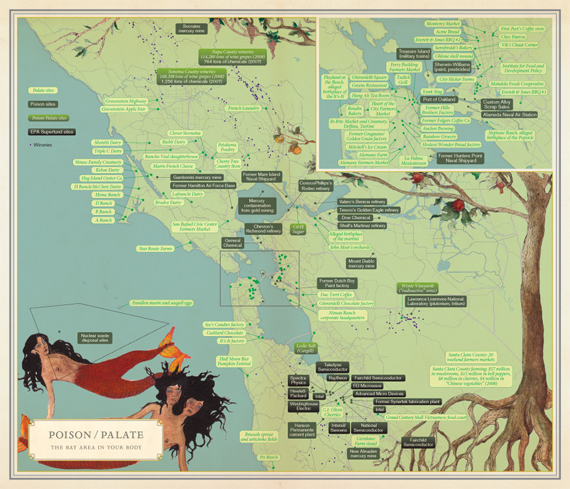
Poison vs. Palate - toxic waste sites overlaid ontop of gourmet foodie destinations -  "What doesn't kill you makes you gourmet"


Old-style movie houses and scene locations from Alfred Hitchcock movies


Infinite City is the only book I've ever read that truly achieves what a map should as an art form. As a student of geography and GIS, I wish I had been more educated on some of her methods and encouraged to try more or Solnit's wildly imaginative interpretations. Few things are as hard to map as history and culture, for these are nonlinear and fluid concepts. As the author states, any interpretation of our sense of place is situated by our individual experience; there are therefore an "infinite" number of maps that each of us could make of the city, and each would be artistically relevant. Infinite City does a great job of highlighting both the more popular stories/folklore of San Francisco through her maps, as well as those most of us are not brilliant enough to imagine. 


Solnit has a keen sense of duality and contradiction, which shows in her cartography. "Poison and palate", the interplay between toxic waste generators and gourmet food destinations and how the two are not at all unrelated. "Phrenology" of the city was another of my favorites. As I finished Infinite City, I was left scratching my head wondering 1) why geography students aren't educated to value maps in the artistic sense; and 2) why aren't there more books like Infinite City for the other great cities of the world! Infinite City is a fantastic read, highly recommended.


That's all for now, folks! I'll be sure to post again when I have more news on the jobs front, if not sooner. To a new life in the Infinite City!

Wednesday, August 24, 2011

Hello, San Francisco!

I have been unforgivably bad about posting on this here blog lately. So much has changed since June I don't even know where to begin, so let's just start with the elephant(s) in the room:

I've moved to San Francisco, CA! No need to worry about this blog having a Seattle bias any longer, as we are now broadcasting from the beautiful City by the Bay. Moving to SF was something I'd talked about several months ago, and I'm happy to report this dream is now a reality!

Matt accepted a job at VolunteerMatch, a non-profit clearinghouse that systematically connects other non-profits with volunteers and interns. Located in San Francisco's Chinatown, they are a Craigslist of the non-profit world, if you will. He started this job in mid-July and has been loving it! Seeing him truly enjoy his work and find his niche is so terrific to see.

I finished up my work with SBM on August 4th, after finishing a major safety compliance audit that was like a capstone to my year of employment there. Though due to various circumstances I may not work in the EHS field ever again, it feels good to have both acquired valuable skills through my work with SBM and to have left the position on such a high note.

We made the move down on August 15th and are now living in a kick-ass apartment on Valencia Street! The location of our place could not have been more perfect. Within walking distance of our place are literally hundreds of restaurants, some of the world's best Mexican food, bike shops, renowned fair-trade coffeehouses, more than a dozen medical marijuana dispensaries (not that I intend on visiting them), a major porno film studio, a chiropractor, churches/temples of Greek Orthodox, Vietnamese Buddhist, Roman Catholic, Jewish and Bahai faiths, and a bar called Zeitgeist which serves San Francisco's best Bloody Mary. For all you real geeks out there, our apartment has a Walkscore of 91 out of 100, above the average San Francisco of 86.

None of this would have happened without the help of our good friend Elyse, who was the previous tenant of our apartment. I happened to stumble upon her Facebook status randomly several weeks ago, where she posted "does anyone want my 2 bedroom apartment on Valencia Street?" I called her immediately and told her to take down that posting right fucking now...and as luck would have it, the place has worked out beautifully! I'm so happy we were 1) able to find a place that met our budget (not an easy feat in the 2nd most expensive rental market in the country); and 2) able to help her move into an even better apartment not two blocks away. Our place has 2 bedrooms, a large kitchen and bathroom, hardwood floors throughout, and my personal favorite feature: the fire escape :) Call me cheesy, call me a stupid boho romantic, but our fire escape kicks ass! I'm still getting used to the noise factor (a.k.a. sleeping with earplugs) and the tight quarters, but what better intro to city living could you ask for than living in a traditional San Francisco apartment in the heart of the city's action?


In the week and a half since moving here, I've made it my personal mission to savor as much of the city as possible before I resume my previous existence as a boring white-collar professional. If there is one San Francisco trait that overwhelms me more than anything else, it is the sensation of being a completely square country-bumpkin surrounded by sophisticated city people. I'm learning more and more that Seattle only thinks of itself as cosmopolitan, and San Francisco is truly its muse. Even the densest Seattle neighborhoods of Capitol or Belltown hardly scratch the surface of San Francisco's great urban environments.

Nearly everyone I've met here thinks I'm a moron for bringing my car into the city. With public transit so good and such high density, wouldn't having a car be too much of a liability? They do have a point, as the meter maids here are ruthless; I managed to get three parking tickets in one week the last time I was here! Granted, I was able to find a parking spot in the Castro for $100/month and my car is paid off, so I'm not complaining too much. The car is at least a 20-minute walk from our apartment, so it adds an extra inconvenience for daily commuting. But regardless, I think there is a certain freedom that having a car nearby offers you. What if I need to travel to a Bay Area suburb not covered by BART? What if I want to make a weekend trip to Muir Woods or Santa Cruz?

Or perhaps the most relevant question considering we just moved in: how the hell are you supposed to get to IKEA without a car? You can't say you've broken your apartment in until your first trip to IKEA! We got a bookshelf, end table, and bathroom cabinet there this past weekend so we're golden on that front. On the other hand, the ability to not need to drive on a daily basis here is quite liberating; the city is compact enough to make nearly everything no more than a twenty-minute walk away. Am I guilty of wanting to have my cake and eat it, too? You be the judge.

In matters more pertinent to this blog, I tested out a key piece of San Francisco bike infrastructure today, also known as the "Wiggle". The "Wiggle" is a highly-trafficked bike corridor leading directly from my apartment on Valencia Street through Duboce Triangle, Lower Haight, Panhandle, and finally Golden Gate Park. The genius of the Wiggle is that it completely avoids the otherwise daunting hills of San Francisco that are a major obstacle in certain neighborhoods. The route is safe and includes a special left-turn lane dedicated to bikes, something I'd never seen before. Streetfilms does a great piece on the Wiggle; what makes the route unique is that it's officially designated with signage throughout, almost like a dedicated path cutting through the heart of the city.


I'm looking forward to volunteering with the bicycle culture here locally, perhaps through the SF Bike Coalition. San Francisco is set to select a vendor for its bike-sharing system sometime this fall, so I'll be sure to keep you updated on that. Despite the temptation of multiple bike shops on Valencia Street, I will NOT be getting a fixie anytime soon. Very happy with my Bianchi, thank you!

On a more practical note, I have an interview with Eventbrite tomorrow for a CSR position. After several weeks of intensive job searching, I can say there is definitely no recession in this city! Wish me luck!

Here's to new beginnings in an incredible new city :)


Saturday, May 7, 2011

California Dreamin'

All right everybody, it's time I leveled with my readers for just a bit. One of the main constructive criticisms I've gotten on this blog is that it's not very personal - there's not enough David-ness about it. I will admit this is true, it's mostly not my style to actually blog about my personal life and way easier to geek out about news, culture, or current events. Guilty! I also worry about the long-term consequences of having a LOT of personal information permanent published to the web. As many folks have discovered, your Facebook, Twitter, Blogspot, and many other profiles leave an indelible residue online even long after you've closed your accounts. Countless hapless people today are in lawsuits over termination from their jobs due to some of the less-than-professional behavior they've posted to the Interwebs. So let's just say I try to err on the side of caution, with some exceptions, and not reveal anything I wouldn't in a job interview or conversation with a stranger in the grocery store. 


Now for a change of pace! Time to get fucking personal for a second. I've been gearing up for a move to California this August for several months now. Part of my motivation for doing so is career-related - I'll just leave it at that :). 


I started looking fiendishly for jobs last year in the run-up to my graduation from UW for two reasons: 1) I wanted to gain a year or two of solid career experience before going back to grad school; 2) I simply didn't know how else to support myself independently. I wasn't comfortable with doing some of the things many of my friends had done post-graduation. Travel the world for a year? Sure, who wouldn't love to do that? I had just studied abroad for six months of '09 in Spain and I honestly didn't want to leave :D But after graduation, when the premise of "academics" (using the term loosely) is gone? How would I justify that to my parents, or to my depleted bank account? In some respects, I regretting rushing into the career world with such intensity and wish I had been more thoughtful about the choice I ended up making. Just because a company wants recent college grads and sounds good in its offer letter doesn't mean it's the right fit. This doesn't mean that my company is a bad company, just perhaps not the right fit at this point in my life. Bottom line: I'm starting to realize I want a bit more excitement and, frankly, danger,  in my life than any 9-5 career-oriented job can give me.


At 23, I have already accomplished a full-time, salaried, managerial position at a major facilities corporation. Sometimes I lose sight of the fact that I'm still young and have many more years of working drudgery ahead of me. Many of the people I meet in a professional context are flabbergasted when they realize my age, as if stunned to see that I've made it to the level of being their perceived equal so quickly. "How did you become a Safety Manager?" (at 23) is one of my favorite questions I could be asked, and there is a long and juicy story behind it for those who are interested. My point is that I've already achieved a lot of what I had intended to when I first entered the career world after graduation last year. So there is no real rush to that next promotion, or even a "lateral move" to another company. Many people who are in their late 20s or even 30s are still waiting tables, temping, "interning", or otherwise indulging in the life stage that's coming to be known as "adultolescence"


Which brings me to California...Ah, yes - magical, sunny, clusterfuck California! Matt and I are looking at California not just because of its weather and for a change of pace - it's the chance to have the freedom and yes, perhaps just a bit of "edginess" that life in Seattle seems to have exhausted itself of. Our friends are intimate and well-established, we have good jobs and a great apartment in a great neighborhood. Everything is pretty much as it should be for we future members of the bourgeoisie :) Perhaps we are already there!

We now have our sights set on San Francisco...wow, let's take a second to let that sink in. SAN FRANCISCO!!! First, San Francisco is almost impossible not to love. It's an intimidatingly gorgeous place filled with exciting, walkable, unique neighborhoods. I want nothing more than to simply be a part of it in this time and place in the world. It is also very expensive, but not nearly as bad as I first thought. A decent two-bedroom apartment in a good area can be had for about $2,000. With Matt and our future roommate (shoutout to my favorite Jewbaby, Rachael Mammen!), this is very do-able even if I were to get a temp/admin job or work as a server. Hell, I could work at a Trader Joes and still afford $700/month! Part of my motivation is to establish in-state residency for when I begin grad school in fall of 2012. My hope is to get into a Masters of Urban Planning program at either UC Berkeley, UCLA, or USC, though I'll also be applying to Hunter College, Columbia, Harvard, UTexas at Austin, and several programs in Europe. I've already taken the GRE's and am working on letters of rec, and I'll be finishing up applications this fall.  California is probably the place cursed with some of the worst urban planning systems in the world, yet also some of its most innovative centers of knowledge. The upscale foodie-industrial complex of San Francisco/Berkeley and the decayed suburbia of the Inland Empire might as well be on different planets. Both have something to offer in terms of unique planning challenges.  Fingers crossed! But grad school won't start until a year from when we move in August. So the way I see it, I have a year to establish residency, work, and make connections. Matt is just returning from interviews this weekend, so he could conceivably move within the next few weeks, in which case I would hold out in Seattle until our lease is up in August. I already have contacts at several very good temp agencies who will be getting my call soon :) And then the next chapter begins!

Looking East from Castro towards the Mission

View from Buena Vista Park in the Haight


Alcatraz - view from Telegraph Hill

Sunset on the Golden Gate

North Beach sunset

Coit Tower
 
Needless to say, California and its opportunities, its culture, its problems have been on my mind a lot lately. I came across this documentary via GOOD magazine. GOOD  has been an invaluable resource to me on California because the whole magazine is pretty much like a place-based Bible circumscribed to fit my interests. They have sections on urban planning, politics, culture, the environment, and economy that seem to predict my interests before I even think of them! They also have great resources on up-and-coming non-profits, movements, and the sorts of under-the-radar issues that end up defining the mainstream news media agenda when it finally pulls its head out of its ass. 


I found this short documentary on California's economic woes and opportunities via the GOOD website. It's a Dutch-produced short film tracking people of varying economic and social backgrounds and how they are tackling life's challenges post-recession in the city of Los Angeles. Subjects include homeless (formerly lower-middle class) families living out of their RV's, ex-gang members, immigrants, and new bohemians in Silver Lake and Los Feliz. Some of the hipsters / bohemians featured around the 39:00 mark really struck a chord with me. The subject is an architect who starts an urban communal farm in the middle of the city. She has much to say about "the way forward" out of California's mess, even giving a shout-out to bike infrastructure, food systems, and other topics my fellow CEPsters would find intriguing. Very interesting stuff, the video is about 40 mins long, I highly recommend you check it out and post your thoughts!

Here's the intro:

"California is a strong brand, the state of new beginnings, dreams and movie stars, of surfers and a wonderful climate. But the Golden State is bankrupt and the city of Los Angeles is running out of cash. Public services are being cut and unemployment keeps rising. At the same time, optimism, entrepreneurship and the belief in the power of America are stronger than ever.
In Los Angeles, we meet five people who are going through a transformation in their lives during this crisis. Justin and Christine lost their jobs and are now living in a van with their two young sons. Charles has gotten out of prison after fourteen years. Mizuko prepares her children for the future by making them at ease in virtual reality. Laura has taken advantage of the crisis by buying land cheaply and starting an urban farm and artists collective Fallen Fruit maps the abundant free 'public fruit' available in the city. Who are the pioneers who are reinventing the new America and how do they see the future?"


Via: GOOD

Tuesday, April 12, 2011

Aurora Borealis Timelapse - Part Deux


I don't know why I've had such a fascination with time lapses lately, or of the Northern Lights, for that matter. They both involve motion, clear skies, and the delights of the natural world.

Or more simply, could it be that I'm just stir-crazy and need to get away? How about to VEGAS in two days? I think so :) That extra-large mojito in the MGM Grand's lazy river sounds spectacular right about now.

This video is a time-lapse shot entirely from this dude's tripod on an Air France flight from San Francisco to Paris CDG. Watch for the Northern Lights to dance around the 1:00 mark or so. Beautiful shots all around. Enjoy!


Tuesday, February 15, 2011

Bike-Only Boulevards: This Would Be Portland's Idea...

In Seattle, late February marks the unofficial start of biking season, because let's be honest, everyone except the most hardcore bike commuters and Critical Mass-types among us has pretty much had their bike sadly rusting away in storage since late October.

So in honor of this, I dusted off my 15-year-old Trek hybrid bike, which had been sitting in my apartment's front doorway almost unused since I moved here in...gulp....September! I'm a terrible cyclist - terrible, terrible, terrible. Bicycling used to be a big part of my life, the one type of exercise I never wanted to quit, the way I discovered new neighborhoods anywhere I went. Hell, a 60-mile ride around Lake Washington was a "training ride" at one point for me not so long ago. I promise to redeem myself this year by doing two things:

1) Train for and do STP, the annual 10,000 rider-strong race from Seattle to Portland. I did STP two years and absolutely loved it!!! There's free food and drinks every 20 miles (a drop in the bucket compared to the 200 miles between the two cities), and my favorite part about it - getting tranced out on my iPod the whole f*cking way there. Wouldn't do it any other way :-)

2) I will devote more space on Green My Fleet to bike-related issues, like bike infrastructure, bike sharing, upcoming rides and events, and bicycle cultures from around the world.

Riding through one of my favorite cities in the entire world - Valencia, Spain
In deference to ultimatum #2, I found a pretty interesting trend that's emerging among the more left-leaning green circles of - where else ?- Portland, Oregon: bike-only boulevards. What's that, you ask? A street where only bikes are allowed - in America??? Impossible. It has to be the psychotic dream of some deranged  hipster twat with chronic anomie and gauged ears! (see below in case you missed the latest episode of Portlandia):


You'd be wrong in thinking that bike-only boulevards are doomed to be an idea of the loony fringe, however. Portland happens to the be the US city with the largest bicycle mode share of 7% (planner-speak for the proportionate ways we get from point A to point B), but it pales compared to bike-friendly cities internationally. European cities take the cake on bicycle population - some 30-35% of all trips are made by bike in most Dutch cities, as well as many cities in France, Germany, and Scandinavia. That most US cities, including Seattle (2% bike mode share), fall way behind Portland is an indictment of our unsustainable transportation system in general.

Portland achieved the success it did by allocating more bike infrastructure - bike lanes, sharrows, bike racks on buses and light rail trains - than any other American city for many years. Portland pioneered the neighborhood bicycle boulevard and the traffic-separated bicycle track that were a first in the US, though hardly elsewhere. A large portion of Portland's large biking population is due not only to its relatively flat geography and outdoorsy culture, but also its 15 neighborhood bicycle boulevards, where traffic is calmed to the point where cyclists almost begin to take precedence over cars.


Recently installed traffic-separated bike track on Manhattan's 9th Avenue, photo courtesy of Seth Holladay of http://www.nycbikemaps.com

Recently, though, Portland's bicycle hegemony may be slipping. Portland was bested by Minneapolis as the most bike-friendly city in America by Bicycle Magazine this past spring. New York City has laid 250 miles of bike lanes in the past three years alone under the partnership between Mayor Michael Bloomberg and DOT Commissioner Janette Sadik-Khan. Meanwhile, bike-sharing systems are sprouting up like weeds across the US, from Washington DC to Denver, San Francisco, and Miami, and Portland is nowhere to be found on this important trend.

Bike-only boulevards represent one of the great bits of uncharted territory for bike infrastructure that Portland and other cities are now looking to tap into. How exactly do you make the transition to a street completely dedicated to bikes? This is something no city in the US can match, and only the densest parts of Amsterdam have any experience with. One of the most important ways to encourage more people to hop on their bikes is to eliminate the threat of riding in traffic, a danger that deters an estimated 60% of "would-be cyclists", that is, people who say they would like to ride their bikes as their primary mode of transport but choose not to.

So by this measure, all of the previous bike infrastructure we've ever experimented with doesn't even come close to meeting people's needs. Bike lanes are often narrow, rarely continuous, and provide zero safety if cars are speeding just inches away from you at 40 miles an hour or more. Most streets lack the space for a dedicated bicycle track, so this option does little for us. Bike paths built on railroad spurs, like Seattle's Burke Gilman, are fun recreational spaces but impractical as commuting paths because they are difficult to integrate with the street network and can only be built where there was once a railroad. Sharrows don't even pretend to give you any space as a cyclist - rather than allocating any street width for bikes, they just paint a bicycle on the asphalt to "warn cars" that bikes might be nearby. Big help that is...

There's already a great deal of evidence in support of bike-only boulevards. The city of Bogota, Colombia, regularly sees almost two million people use its 100-mile plus system of bicycle boulevards that are closed on Sundays as part of its Ciclovia (Spanish for "bike-highway"). Los Angeles copied the event with its own CicLAvia series and likewise saw a huge increase in people out on their bikes. Why? Because the bike-only boulevards remove car traffic and finally make people feel safe being on their bikes.

As cities grapple with how to become more sustainable, we're set with some very big goals to achieve. San Francisco aims to have 20% of its residents moving by bike in just ten years, by 2020. Portland is aiming even higher, 25% bicyclists by the same year. It might just take something otherwise considered radical to hit targets like these. The San Francisco Bike Coalition is lobbying the city's Board of Supervisors to install 27 miles of bike-only boulevards that connect the most important commercial and transit hubs. I can only suspect a proposal like this would cost far less than what the city has spent so far on who knows how many bike lanes.


The bike-only boulevard trend is even spreading to cities as ass-backwards as Seattle. A "neighborhood greenway", borrowing Portland's granola terminology, is planned for the NE 45th St. corridor in Wallingford.

Will these bike-only boulevards work as truly functional transit arteries, and not just a fun Sunday recreational pastime? If the two boulevards installed in London recently are any indication, we needn't worry about that. Bicycle traffic went up 70% in less than a year since installation, which speaks volumes about the difference good infrastructure makes in our transportation choices.

In case you needed any more motivation to be on the look out for bike superhighways, check out this statistic:

According to a report from the Political Economy Research Institute, a think tank based out of the federal Department of Transportation, construction on bike and pedestrian infrastructure creates TWICE the number of jobs per dollar spent than road construction. Take that, Tea Party assholes!