Showing posts with label geography. Show all posts

Tuesday, September 20, 2011

A New Life in the Infinite City

It has been a little over a month since I packed my bags, loaded up the UHaul, and set sail for San Francisco. Since then, my main priority has been finding a job (or even a part-time "yob"). So apologies, again, for not maintaining this here blog up to my usual standards. As of this writing, I have not yet found a job but have made some good progress to that end. At the very least I have interviewed for positions far more frequently than I could've ever predicted. 


For those of you who're interested, here is a brief update on the job search:


First, the bad news...I have been rejected for the following positions:

  • Sales coordinator position at a Facebook-related, early-stage startup in SoMa (rejected after two interviews)
  • Customer service position at an events and ticketing late-stage startup in SoMa (rejected after two interviews)
  • Executive assistant position at an international non-profit foundation (rejected after one interview)
  • Admissions representative at a private university Downtown (rejected after one interview
  • Recruiting position at a pharmaceutical staffing agency (declined the position after a phone screen)


Now for the bright spots of the job search, for opportunities still pending:

  • Project coordinator position at an affordable housing developer in Civic Center - this is the opportunity I'm most excited about :)
  • Policy analyst at an insurance-related non-profit Downtown
  • Contracts clerk at a solar company in San Mateo
  • Admin at a private university Downtown
  • Project coordinator position at a climate change think tank in Berkeley
  • Two large temp agencies


So as you can see, not all is lost as the job hunt goes on. The positions that are still in the cards for me are far and away much better fits than those for which I've been turned down. I sometimes forget in the stress of applying to and interviewing for jobs that as much as the employer is interviewing you, you are interviewing the employer to find the best match for you. 


The importance of this is easy to overlook when at the end of the day I just need a job to pay my bills. But will it be a job that I enjoy, somewhere I can thrive over the long-term and find real growth opportunities and maybe even a career? Something tells me it was for my own good that the sales and customer service-related positions passed me over. Perhaps they sensed (correctly, I think) that I wanted more out of a job than answering phones all day or mindlessly crunching numbers. Dare I say it, I want a career and not just a dead-end job? So those outcomes can be seen as a blessing in disguise, I suppose.


In the meantime, I cannot praise the temp agencies in San Francisco highly enough. If you ever find yourself unemployed (or under-employed) in a big city like SF, I highly recommend that you get yourself into the local temp agency for an interview. 


The first temp agency I met with (who will remain confidential as I am still working with them) was tremendously helpful. I was referred to the agency by my good friend Elyse, who got a kickass job at Pandora with their placement services. She began as a receptionist and has since been promoted twice, first to recruiter, now to events specialist. She has been working there since January, mind you. Elyse is also responsible for helping us find our apartment and has truly been an indispensable resource in helping us getting established here. Love you, Elyse! Her story is one that I think could only happen in a place like San Francisco.


So after Elyse referred me to the temp agency, I applied for several jobs within a few days of getting into town. Not even twelve hours later, I get an invitation to interview with one of their recruiters. Now that's service! 


The first woman I met with took one look at my resume and made clear, precise recommendations for several types of positions, such as administrative, sales, or customer service. She told me what to cut (a lot!), what vocabulary to change, and what to embellish for my job search. Another woman I met with had already reviewed my resume and had a position at a biodiesel company already in mind. The position ended up not being available, but the fact that she was able to recommend me for a position in a field I've already blogged about here is a testament to her diligence.


The agency also hooked me up with several days' temp work as an usher at the recent Dreamforce conference at Moscone Center, run by the local software giant Salesforce.com. In case you're wondering what the hell Salesforce is, don't worry...Salesforce is the future, and the future is terrifying! It's basically a sales database system that combines the powers of every social network into one: Facebook, Skype, Twitter, LinkedIn, and Amazon.com, all seamlessly integrated. 


Imagine the following scenario: you walk into a Nordstrom's and buy a pair of jeans. Upon ringing you up at the register, the sales clerk registers the transaction into Salesforce, where not only your credit card information, but also your Facebook profile, Twitter feed, blog presence, and nearly every other social footprint online is stored. An inquiring salesperson or advertiser would then be able to search your profiles and "recommend" your next purchase based on the interests you've expressed on your social networks as well as those expressed by any of your hundreds of online friends.


Maybe I'm being paranoid here, but this technology is quite frightening and makes me take pause at how my online presence could potentially be used for sinister purposes. After ushering the VIP section at the Dreamforce keynote address by Marc Banioff, I can tell you that what I've described is merely just the beginning of what Salesforce has in store. Coming soon are internal company Facebook-like social networks, where any employee in a closed network can post company updates, share documents, or even schedule online conferences. 


Let's take the next technological leap into the future for a second. Facebook has recently announced a hair-raising new facial recognition technology. You heard right. Technology now exists that can search for and locate your Facebook (and countless other Internet profiles) based on a quick and dirty photograph of your face. See below:


video platformvideo managementvideo solutionsvideo player


Now let's take a paranoid leap of faith and assume that enterprising companies like Salesforce snap up this technology in a split-second, paying no heed to the public's concerns over breach of privacy. Because you know that's exactly what will happen. Now the sales clerk at Nordstrom's need not have your credit to look up your social presence online. It can now be done by video cameras the instant you walk into the store. Is it just me, or does this not sound exactly like one of the more disturbing scenes from Minority Report?


Run for your lives, children! The future is already here...


Now for less depressing geekiness. My mom gave me the book Infinite City before I left for San Francisco. It is nothing less than one of the most interesting books I've read in years and was the best possible book I could've read before moving to the city. Infinite City is a collection of maps and accompanying essays that charts the social, economic and cultural history (and future) of San Francisco through the lens of very diverse groups. Written with the premise that every person who lives in the city could write their own infinite series of maps based on their individual life histories (places of residence, watering holes, restaurants or markets they frequent, places they walk their dog) that themselves comprise the fabric of the city. It is a radical concept, that cities are composed of a tapestry of millions of individually situated maps of our livelihoods.


Here are some of the best examples of this type of psychogeography:


The "phrenology" of San Francisco - the city as it reflects within the human psyche


Gay bars and endemic butterfly species - a great pairing if there ever was one!


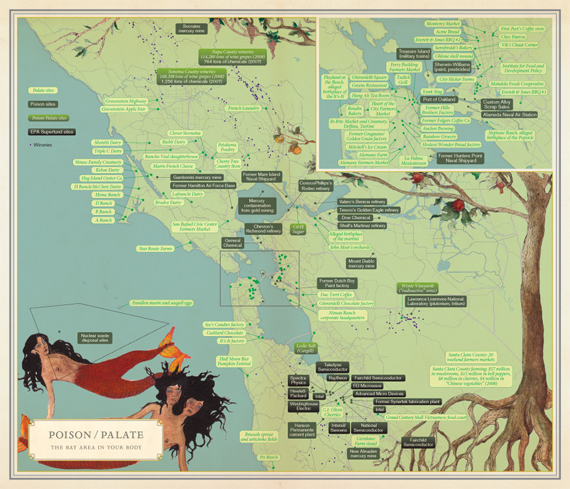
Poison vs. Palate - toxic waste sites overlaid ontop of gourmet foodie destinations -  "What doesn't kill you makes you gourmet"


Old-style movie houses and scene locations from Alfred Hitchcock movies


Infinite City is the only book I've ever read that truly achieves what a map should as an art form. As a student of geography and GIS, I wish I had been more educated on some of her methods and encouraged to try more or Solnit's wildly imaginative interpretations. Few things are as hard to map as history and culture, for these are nonlinear and fluid concepts. As the author states, any interpretation of our sense of place is situated by our individual experience; there are therefore an "infinite" number of maps that each of us could make of the city, and each would be artistically relevant. Infinite City does a great job of highlighting both the more popular stories/folklore of San Francisco through her maps, as well as those most of us are not brilliant enough to imagine. 


Solnit has a keen sense of duality and contradiction, which shows in her cartography. "Poison and palate", the interplay between toxic waste generators and gourmet food destinations and how the two are not at all unrelated. "Phrenology" of the city was another of my favorites. As I finished Infinite City, I was left scratching my head wondering 1) why geography students aren't educated to value maps in the artistic sense; and 2) why aren't there more books like Infinite City for the other great cities of the world! Infinite City is a fantastic read, highly recommended.


That's all for now, folks! I'll be sure to post again when I have more news on the jobs front, if not sooner. To a new life in the Infinite City!

Wednesday, January 26, 2011

So...What Do You Do Exactly?


Every so often, I find an article that hits the nail on the head for exactly what I wish I could say, if only so eloquently. When I was in school at UW and told people that I studied urban planning (don't even get me started with Geography!), I was met with blank stares and mild eye-rolling 90% of the time. You wanna do what now? The other 10% probably has some idea of the profession and assumes you are either a) an architecture school reject or b) a lost hippie who wants to create urban farms to feed organic food to the homeless - don't worry, some of us still do!

Really urban planning is much more simple than that. I want to be able to take people's vague ideas of what a "sustainable" future is supposed to look like and put them into practice. Are you happy with your current lifestyle? Do you worry about pollution and its effect on your health? Do you hate your morning commute and wish there was an alternative to sitting in your car wasting fuel while you idle? Do you wonder why you can't walk to your corner store the way your parents could? Ever wonder how your city will restructure itself due to the recession? Where its jobs will come from? Well, that's where urban planners come in. Because I'm terrible at explaining things like this, I'll leave it to a PhD student at UMaryland whose full article is below:
It happened again, as it invariably does every holiday season. In the midst of spiced eggnog and office holiday parties or visiting with family and friends, I get asked a simple question: “What do you do?” I politely say, “I study urban planning.” And then there’s the inevitable silence as I wait for the quizzical follow-up – “What’s that?” – and another brooding year of Christmas heartache. However, this year something changed. After I uttered my usual phrase, “I study urban planning,” my speech was met with a “Wow, that’s really cool,” and “Ah, that’s interesting, I have a friend who is studying that,” or my personal favorite: “I wish I had gone into planning rather than settle for law school.”  Yes, the field of urban planning was met with unbridled enthusiasm as I made the rounds this holiday season. A Christmas (or Hanukkah) miracle? I think not.
The plain truth is that urban planning is hot. If we take a look at the numbers, according to the Department of Labor, the urban and regional planning field is expected to grow by nineteen percent, from 38,400 jobs in 2008 to 45,700 jobs by 2018. Moreover, quite apparent is that a burgeoning global population has created the need for additional infrastructure including transportation systems, affordable housing, and schools while simultaneously existing infrastructure needs repair and restoration. It is no wonder that U.S. News and World Report included urban planning as one of the fifty best careers for 2011. But this is really just the beginning. 
In his notable work, Planning in the Face of Power, John Forester describes planning or designing as “a deeply social process of making sense together.” Planners, to appropriate the sociologist’s C. Wright Mills language, translate personal troubles into public issues.  Moreover, they help individuals and communities communicate and develop visions for the future based upon shared interests, values, and norms. In a time and place where the prospect of the future seems uncertain, unsettling and even frightening at times, the expertise that planners bring is needed more than ever. In this context, a perfect storm of factors is contributing to an auspicious growth for the field. 
Let’s be straight: Urban planning is and traditionally has been a relatively obscure field in a relatively obscure set of disciplines known as the social sciences (we like to talk things out). In her article “Planning Theory’s Emerging Paradigm: Communicative Action and Interactive Practice,” Judith Innes writes, “There are probably 1,500 people today who hold a planning Ph.D. The proportion of educators with a Ph.D. in planning is steadily increasing.” This was in 1995. Today, my educated guess is there are in the range of 2,500-3,000 people with planning Ph.D.’s and they are in more places than walking the corridors of the Ivory Tower both here and abroad. You can find them in think tanks, NGOs, law firms, and public policy organizations. In terms of academia, one only need take a glance at the Job Bank on the Association of Collegiate Schools of Planning (ACSP) website to see the plethora of faculty jobs available. Indeed, the L. Douglas Wilder School at Virginia Commonwealth University (VCU) alone has announced it will be filling ten or more tenure-track or tenured positions in the coming two years. Ten positions! That’s larger than the entirety of many planning departments, and along with a number of new positions, the field is seeing whole programs commence and become newly accredited including those at Boise State University and the University of Louisville, among others. To put this in perspective for those new to the field, the annual planning conference for academics draws between 400-500 individuals yearly. The field is not large; we aren’t talking a department of history, economics, or political science here. We are talking about a field where there are at present fifty-four openings for urban planning faculty (I counted). 
Why all the activity?  A constellation of factors are at play, including:
• The first full generation of trained planners are on the eve of retirement
• The growing relevance and significance of planning, both locally and globally from Dubai to Detroit reflected by the ascent of wealth and the capacity to build mega-project (e.g. as in Dubai), but also the ascent of poverty resultant from failed public policy, markets, and structural economic forces (e.g. Detroit)
• The growing visibility of planning through media (including this magazine) and the blogosphere thereby precipitating more interest from the general public

As both supply and demand factors continue to incentivize the field, the explicit notion that both individuals and communities are looking for answers and find themselves increasingly reflected in the language of planning, whether tacitly or knowingly, begs the question: What does this emergence mean for how we train planners for the future? It is a question that generations of planners have considered, including Paul Davidoff and Judith Innes. 
Davidoff, regarded as the founder of advocacy planning, described in his 1965 article Advocacy and Pluralism in Planningthe need to broaden the scope of a planners’ education. He wished to widen the focus of planning to include all areas of concern within government. He speaks to the primary role the planner has as a coordinator and suggests that two years of graduate study may be insufficient to broadly train planners for this difficult job. Judith Innes, writing in the mid-1990s, notes the importance of allowing students to take over their own learning processes. She references an anecdote in a teaching workshop she attended which imbued her with a Deweyian lesson, “that learning by doing has far more power than simply learning by reading or listening and that social learning – learning as part of a group effort – has important advantages over the solitary investigation of the lonely researcher.” More recently, Leonie Sandercock contends the need for “therapeutic” processes to transform urban spaces from places of fear (racial, socio-economic, etc) to places of cohabitation and coexistence. Such processes could be structured in helping residents organize meetings in moving from fixed positions to shared interests. These three scholars are but three voices over planning’s lifespan that add to the discourse on planning pedagogy. The ascent of issues such as all things sustainability-related, social justice, and international development planning only contribute to the dialogue on what a planner should be learning.   
Peter Bosselmann, a professor of urban design in architecture, city and regional planning, and landscape architecture at the College of Environmental Design at the University of California, Berkeley, notes that among his students,
There’s an interest in international work right now, which probably has to do with the economy . . . Geographically, China is very important, as is India, and we assume that soon the urbanization of Africa will start becoming of interest. [Topic-wise], the environment is becoming stronger and stronger, especially the forces of nature and how they’re acting on cities, such as the rising of water tables.”
What so many of us love about planning is that it is dynamic. And urgently so. From the growing wealth gaps in the United States and globally, to environmental issues, individuals come to planning because they wish to effect change. We can only hope that as the institution of planning moves into the next decade, planners will be more cogent of their past, their context, and their responsibilities to their craft in embracing this dynamism. No Christmas (or Hanukkah) miracle required. 
Via: Planetizen

Wednesday, January 19, 2011

Looking Up Your Bus Route Should Not Be a Chore - Seattle Transit Frequency in One Easy to Use Map

Don't you hate it when you try to look up a bus time, and 10 minutes go by as you try to understand the oh-so-cryptic bus schedule information and route maps? For many of us, it's one of the biggest turn-offs to taking public transportation.

I can remember so many times when I would become trapped in remote areas like Factoria, Kingsgate, or Overlake because I misread a bus route map and caught the wrong bus, only to find that the next bus I was looking for didn't come for another two and half hours!!!

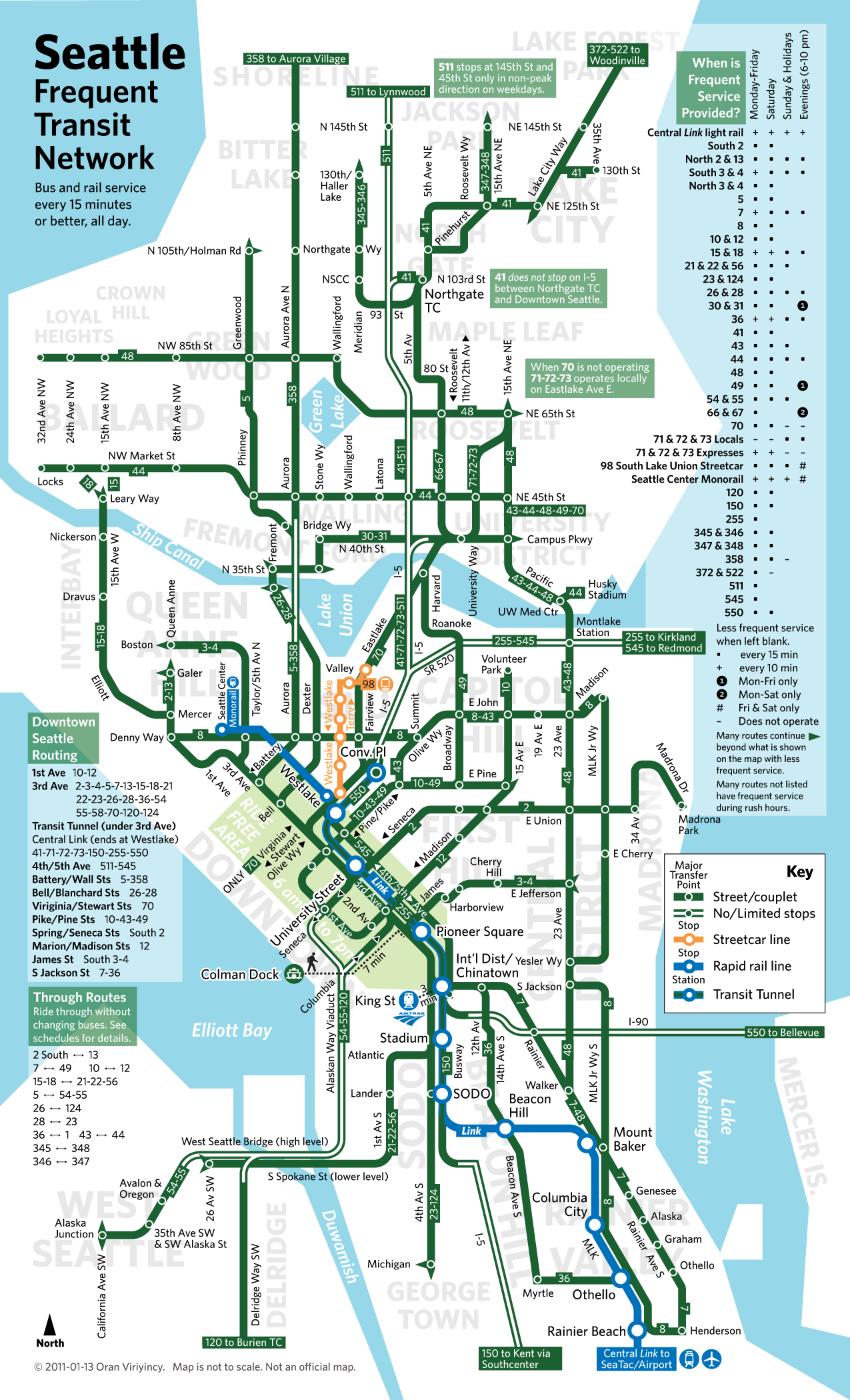
Thankfully, the good people of the Seattle Transit Blog have come to the rescue with this handy map of bus frequency in Seattle. This is an easy-to-use resource that shows all bus routes that have a frequency of 15 minutes or less - that is, they stop every 15 minutes. Realistically, people are only going to use public transit if they don't have to plan every single trip according to its schedule (hence the 15 minute frequency) and if routes are logically placed.

What's not surprising about this map is the extent to which it shows how imbalanced the transit density of Seattle is - Downtown, Capitol Hill, and the U-District pretty much have the greatest number of high-frequency buses, while the rest of the city is left high and dry. Part of this is due to the fact that it's easier to build transit in high-density areas, and part of it is due to budget cuts and bad planning on the part of King County Metro. In particular, the scarcity of frequent buses in West Seattle and Lake City is astonishing - these areas aren't exactly out in the boonies!

I'm sure this map will become my best friend as soon as I start taking the bus more due to the horrendous tolls coming this spring on 520.

Check it out!


Via: Seattle Transit Blog

Saturday, January 8, 2011

Seattle Bike Share Comes Closer to Reality

In the past six months, there's been a wealth of attention devoted to starting a bike-sharing system in Seattle. In November, I wrote about the first feasibility study done for bike-sharing in Seattle, a collaboration between SDOT and the UW.

The UW study divided the city into 10-square-meter cells and ranked them based on factors like residential population density, job density, retail density, proximity to transit, and existing bike infrastructure.

The result is a detailed portrait of where bike-sharing is most likely to succeed in Seattle. The results of their analysis suggest that bike-sharing should first be rolled out in the downtown core, Lower Queen Anne, and Capitol Hill neighborhoods. These neighborhoods both have very high residential density and walkability, extensive bike and transit infrastructure, and are full of retail and tourist destinations.

Photo courtesy of Publicola and the UW Bike Share Studio

Phase 1 of the proposed bike-share system begins with the green zone of downtown and its immediate neighbors Lower Queen Anne and Capitol Hill, along with parts of the Sodo stadium district. Continuing down the hierarchy of density, the system would be later expanded in Phase 2 to include Upper Queen Anne, Eastlake, the Central District, Beacon Hill, Ballard, Fremont/Wallingford, and the U District. Lower density neighborhood centers, known in City of Seattle parlance as "urban villages" would be the last to be added in a Phase 3. 

According to Seattle Transit Blog, King County is currently seeking a $150,000 federal grant to get the pilot Phase 1 off the ground. The program would launch first in the green downtown areas with between 800 and 1,000 bikes, with a capital cost of $3,500 - $4,500 per bike. Operational costs would average $1,200 to $1,600 per bike, which would be paid through monthly or annual user subscription fees in the range of $45-$75 per year with an hourly rate after the first free half-hour.

The King County planners STB interviewed seemed to indicate that Redmond (with its large high-tech workforce) be included in the Phase 1 and the suburban centers of Bellevue, Kirkland, Renton, and Kent would be included in the Phase 2.

The UW study explicitly recommended against this approach of including outlying population centers in the initial phases so as to not create a disjointed, less functional system. They even recommended not including the U District in the initial Phase 1, despite the high student population and retail density, because of the lack of bike connectivity with the downtown center. We'll have to see if King County follows this reasoning in their final proposal.

Also unclear is whether the County would require helmets on users of the bike-share system - most European systems have done away with their helmet laws completely to boost their ridership, and this approach seems to have been its saving grace. Will our litigious American culture subside enough for helmet laws to be relaxed? Or worse still, will there be vending machines at the bike stations to sell helmets? That just sounds like nanny-state ridiculousness, but with Seattle you never know!

A second interesting study was done in April by an STB writer, Adam Parast. He did a GIS analysis of the current bikeability of Seattle versus Portland. The project compared factors of street connectivity, existing bike infrastructure, slope, land use (proxy for density) and barriers (like a freeway interchange or an impassable slope). The result? Not surprisingly, Portland takes the cake on bikeability in nearly every respect.

Due to a combination of our more challenging geography (Portland has it easy lying in a mostly flat river valley) and our comparative lack of bicycle infrastructure, Seattle is reduced to "islands of bikeability" in a hostile, car-centric sea. One of the more surprising and extensive bike-friendly areas is Ballard. Should this area be included in Phase 1? It's about 10 minutes away by bike from the downtown core via 15th Ave. W and Elliott. Also in its favor: its fast-rising residential density, numerous tourist attractions, and largely self-sufficient retail district.

Current bikeability comparison, blue = high bikeability, red = low bikeability

Potential bikeability comparsion

More good news for bike sharing: bikes travel faster than cars during rush hour in most cities! According to a study out of Lyon, France's bike share system, bicycles are faster and more direct than cars in high-density areas during rush hour because of the complications of circling the block to find parking and then finally walking to your destination. Intuitively, this makes sense in Seattle - you can ride your bike between Downtown, Capitol Hill, and the U-District faster than rush hour car traffic.

King County is looking to launch the Seattle bike-share system by summer 2012, so there's sure to be a lot more going for bike-sharing locally, and a lot more reporting to come from Green My Fleet!

Via: Planetizen and Publicola

Tuesday, January 4, 2011

"Ugly Tourism" Takes Off - Welcome to Cleveland, Bitch :)

As if by some stroke of God, one day I'm writing about the schadenfreude of looking at Detroit's "feral neighborhoods" and how the city could be cashing in on a micro-niche of "ugly tourism." Today we are serendipitously greeted with this perspective on Detroit's slightly less corroded neighbor to the east, Cleveland.

Like Detroit, Cleveland has been shedding jobs and residents for decades, and there is little hope for its long-term economic future. But why be such a debbie downer about it? The upsides of economic decline are cheap (cheap!) housing, affordable bars and restaurants, and an unpretentious, no-frills attitude towards life. Why stress out about which college you'll go to when there are no jobs for college grads in your city anyway? Poverty is simple and low-maintenance, argues Mike Polk in the video below:


"Come and look at both of our buildings"
"Watch poor people all wait for buses"
"Here's the place where there used to be industry"

Can you make a rap like this about your city?

Come on, Tacoma, you know you want to :)

Via: GOOD magazine

Monday, January 3, 2011

The Feral Houses of Detroit - Part Deux

Last week we covered one of the more spectacular and haunting side effects of the dramatic decline of Detroit - the rise of "feral houses" and even "feral neighborhoods" that are so thoroughly abandoned they revert to a natural state.

Part of the City of Detroit's economic rescue plan involves essentially withdrawing from nearly one-quarter of the city's land area and letting it become wild. Cut off your nose to spite your face. For those living in Detroit, this must be a stunning reality that not only has the city been in sharp decline since the 1960s, it is completely evacuating large sections of once elegant neighborhoods just to remain financially solvent. Once among the richest of American cities, it now seems more like an internationally famous ghost town. Our version of Somalia, if you will.

A note for the Detroit Chamber of Commerce: "ugly tourism" is all the rage right now in Europe. Like "slum tours" through the favelas of Rio de Janeiro or "grief tourism" to the killing fields of Cambodia and Auschwitz, Detroit needs to take advantage of its clear monopoly on decay and the powerful story of its riches-to-rags downfall. Might I suggest a marketing slogan to tempt the more thrill-seeking among us? "Zombieland Detroit: And You Thought it Was Just a Movie"

This series from the Guardian has excellent photos of the interiors of some of Detroit's most tragically derelict buildings. The incredible thing about many of these shots is that so many of the buildings appear to have been abandoned so suddenly and without planning, with knicknacks and personal belonging still left untouched decades later. In many ways it's eerily reminiscent of post-Katrina, except this disaster was entirely man-made. All photographs by Yves Marchand and Romain Meffre.
East Methodist Church
Detroit’s Vanity Ballroom with its unsalvaged art deco chandeliers. Duke Ellington and Tommy Dorsey once played here.

The biology classroom at George W Ferris School in the Detroit suburb of Highland Park

Dentist's station, Broderick Tower

Light court - Farwell Building
Michigan Central Station

Michigan Theater - now a parking lot?
Former police station, Highland Park
The ballroom of the 15-floor art-deco Lee Plaza Hotel, an apartment building with hotel services built in 1929 and derelict since the early 1990s

The ruined Spanish-Gothic interior of the United Artists Theater in Detroit. The cinema was built in 1928 by C Howard Crane, and finally closed in 1974
Waiting Hall, Michigan Central Station

Livingstone House, designed in French Renaissance style in 1893, demolished after this picture was taken.

Via: Planetizen

Thursday, December 30, 2010

EV Charging Stations Coming to...A McDonalds Near You?

We've all heard the old, tired line before: environmentalism is an affectation of the rich; only latte-sipping liberals care about their carbon footprint; my personal favorite - urban planning is a socialist Obama conspiracy against the suburban neighborhoods where real, red-blooded Americans live.

Some of these pathetic arguments may be put to rest by one of the more surprising developments in EV charging infrastructure. They're installing EV stations at, you guessed it, the McDonalds near you. Specifically, two Level 2 charging stations are being installed at this McDonalds in Huntington, West Virginia.

You know electric vehicles like the Chevy Volt and Nissan Leaf (and Ford Focus electric, hitting the market in 2012) have arrived when any given McDonalds will have spots for drivers to plug in their vehicles.

McDonalds charging station in the Netherlands, courtesy of EVworld.com
If we can corner the fast food market with EV stations - that is, make them an easily integrated and functional part of our fast-food/strip-mall landscape - we just might have the shot in the arm needed to kick our addiction to fossil fuels.


Photo courtesy of The Happy Hospitalist
 The map of McDonald's locations across the US begs the question of "where isn't there a micky dees near me?" Could it one day lead to the same question about charging stations? Let's fucking hope so!
Via: CityFix

Tuesday, December 28, 2010

The Feral Houses of Detroit

When you think of the word "feral", is it a rabid dog or cat that first comes to mind? Or, perhaps a feral Gypsy child running through the slums of Calcutta, surviving on only heroin and garbage snacks.

But a feral house? This is an entirely different category of bizarre. In the city of Detroit, long a poster child of American urban decay, things have gotten so bad in many of its wards that thousands of houses - entire neighborhoods, even - can now be described as "feral".

Due to decades of industrial decline, economic disinvestment, political corruption, and failing city services, Detroit's population has declined from over 2 million in 1950 to just 900,000 today.

According to a recent article in City Journal, the mayor of Detroit, Dave Bing, plans to "shrink" the city even further to 700,000 to allow it to thrive. As it stands today, nearly 70,000 houses stand abandoned - many to such an extent that they are completely engulfed by vegetation in the summer months. Nonetheless, the city msut still provide services to the few remaining residents of these feral districts at great cost.

Under Bing's plan, nearly one quarter of the city's land area would be returned to forest and woodland, fully depopulated of its residents, who would be relocated to other areas. With the exception of certain areas like the Lower Ninth Ward in post-Katrina New Orleans, this is almost unprecedented for any American city.

These feral areas of Detroit may be the closest thing America has to a truly 3rd World standard of living, outside of Indian reservations. Places where only arrests are made on only 37% of murders (compared to 65% nationally), and police coverage is so irregular that many residents no longer call 911 to report crimes because the police simply don't bother to show up.

Detroit's Dave Bing, a former NBA star, has often been compared to Newark's Mayor, Cory Booker, a reformist who has taken charge against the staggering odds in a "crime capital" of America. If his redevelopment plan of Detroit works, hopefully these "feral neighborhoods" will become a thing of the past, a marker of the worst of deindustrialization in the Rust Belt. In the meantime, these houses are as increidble as they are sad.


Click here for a full map of the Detroit feral houses.

Via: Sweet Juniper

Friday, December 17, 2010

What Does Facebook Look Like from Space?

Have you ever wondered what the world of Facebook would look like if you plotted friendship ties along a map? Well, neither had I, until I read about this Facebook INTERN's amazing project.


The method to the intern, Paul Butler's, madness?

I defined weights for each pair of cities as a function of the Euclidean distance between them and the number of friends between them. Then I plotted lines between the pairs by weight, so that pairs of cities with the most friendships between them were drawn on top of the others. I used a color ramp from black to blue to white, with each line's color depending on its weight. I also transformed some of the lines to wrap around the image, rather than spanning more than halfway around the world.
Interesting how all of China, nearly all of Africa, and most of Russia are almost entirely dark on the Facebook map. Censorship, anyone?

Via: GOOD

Tuesday, November 23, 2010

It's Absolutely "Mapnificent"

You know you're a geek when you go gaga for something like this.

Mapnificent  is a Google maps interface that plots the areas of a city that are accessible by biking, walking, and public transit within the point of reference you select.

It visually frames the city in a more relevant way for sustainable development. Instead of merely *hoping* that people ditch their cars for bikes and public transit, this could be a tool to assess potential alternatives just by entering your address, not unlike the site Walkscore already famous in the real estate industry.

Here's a couple cool examples from right here in the busiest neighborhoods of Seattle.

Downtown:


Capitol Hill:

University District:

Tuesday, June 1, 2010

Topics, Trends, and Twitters - Planning in the Next 50

This is a presentation I helped to create for the Next City Next 50 symposium, an event celebrating the 50th anniversary of the Masters in Urban Planning (MUP) degree at the University of Washington.

My co-presenters were Associate Professor Dennis Ryan, Affiliate Professor Jill Sterrett, and Karen Wolf, Strategic Planning and Policy Division Manager for King County.

This presentation focused on the top trends that urban planners will face in the next 50 years. These top trends include food and water security, climate change, social equity, new urban design, demographics, collaborative education, transportation and health, regionalism, and social networking technology (Web 2.0).

I presented on the applications of social networking in urban planning (last 3 slides) to a panel of MUP alumni on January 31, 2010.


Wednesday, May 12, 2010

URBDP 422 - Final Project with Daniel Rowe, December 2009

This was the Final Project for Urban Planning 422: Urban and Regional Geo-spatial Analysis. If that title doesn't sound intimidating enough for you, I was the only undergraduate in a room full of grad students. The requirements for the class? Ten labs (about two hours each), a midterm, a final exam, about 200 pages of reading that were never discussed in class, and a quarter-long project itself with two outside interviews and three other intermittent deadlines. No big deal, right? :) Well, here's the result of this painful SOB that made me realize at least one reason I may hold off on grad school for a while - to avoid going completely fucking nuts!

Special thanks to Daniel Rowe (UW Masters of Urban Planning Program), Colette Flanagan (King County DOT GIS Support), and Chad Lynch (City of Seattle GIS Supervisor).